8. týden: Propojování drátové a bezdrátové, programování aplikace Week 8: Wired and Wireless Connectivity, Application Programming
Během osmého týdne bylo úkolem: During the eighth week, the task was to:
- Ovládat obvod přes lokální bezdrátovou síť. Control a circuit over a local wireless network.
- Vytvořit aplikaci, která bude fungovat jako uživatelské rozhraní pro komunikaci se vstupním nebo výstupním zařízením. Create an application that will function as a user interface for communication with an input or output device.
Dálkové ovládání a vizualizace stavu hexapoda Hexapod remote control and status visualization
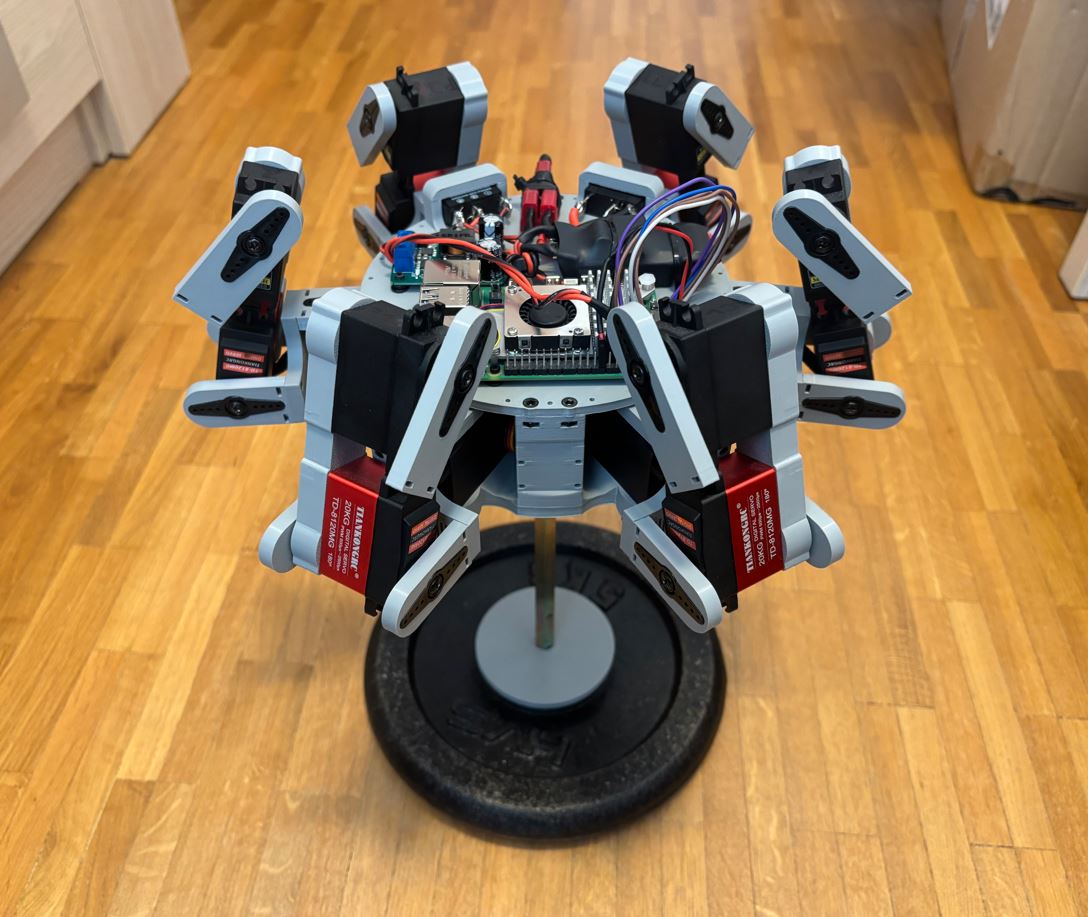
V předchozích týdnech jsem postavil funkční základ hexapoda (zbývá už jen kryt elektroniky a poslední články nohou) a Bluetooth dálkové ovládání. Cílem tohoto týdne bylo implementovat inverzní kinematiku, zprovoznit komunikaci mezi robotem a ovladačem a vytvořit PC aplikaci pro vizualizaci pohybů robota. In previous weeks, I built the functional base of the hexapod (only the electronics cover and the last leg segments remain) and a Bluetooth remote control. The goal of this week was to implement inverse kinematics, get the communication between the robot and the controller working, and create a PC application to visualize the robot's movements.
Arduino v ovladači bude s Raspberry Pi 5 v hexapodovi komunikovat pomocí Bluetooth a Raspberry Pi bude odesílat svůj aktuální stav do počítače prostřednictvím protokolu UDP. The Arduino in the controller will communicate with the Raspberry Pi 5 in the hexapod via Bluetooth, and the Raspberry Pi will send its current state to the computer via the UDP protocol.
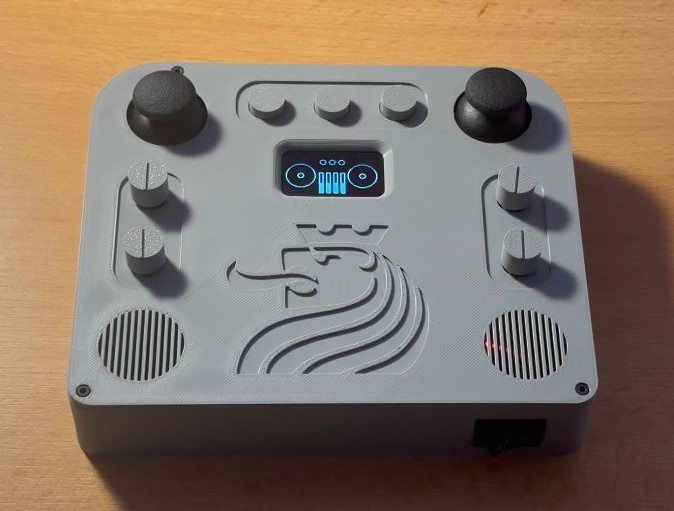
Dálkové ovládání hexapoda Hexapod remote control
Dálkové ovládání aktuálně poskytuje kontrolu nad náklony těla (roll, pitch a yaw) a jeho posuny ve třech osách (x, y, z). K tomu využívám pravý joystick (včetně jeho tlačítka) a oba pravé potenciometry. The remote control currently provides control over body tilts (roll, pitch, and yaw) and its translations in three axes (x, y, z). To do this, I use the right joystick (including its button) and both right potentiometers.
Výchozí režim joysticku ovládá posuny těla v osách X a Y. Po stisknutí tlačítka joysticku se režim přepne na ovládání náklonů (pitch a roll). Potenciometry pak slouží k nastavení výšky těla (posun v ose Z) a rotace (yaw - otáčení kolem osy Z). The default joystick mode controls body translations in the X and Y axes. After pressing the joystick button, the mode switches to tilt control (pitch and roll). The potentiometers then serve to adjust the body height (translation in the Z axis) and rotation (yaw - rotation around the Z axis).
Komunikace mezi Arduinem (ovladač) a Raspberry Pi 5 (hexapod) probíhá jednosměrně přes sériovou linku a Bluetooth modul HC-05 pomocí vlastního protokolu. Na Raspberry Pi běží vlákno bluetooth_thread, které paralelně s hlavní smyčkou čte a zpracovává příchozí data.
Communication between the Arduino (controller) and the Raspberry Pi 5 (hexapod) is one-way over a serial link and the HC-05 Bluetooth module using a custom protocol. A bluetooth_thread thread runs on the Raspberry Pi, which reads and processes incoming data in parallel with the main loop.
Formát datového paketu: Data packet format:
-
Byte 0:
0xAA- Startovací byte (hlavička), podle které RPi identifikuje začátek paketu. Byte 0:0xAA- Start byte (header), by which the RPi identifies the beginning of the packet. -
Byte 1:
0x11(17 desítkově) - Délka užitečných dat (payload). Byte 1:0x11(17 decimal) - Payload length. - Byte 2 až 17: Analogová data z potenciometrů a joysticků (osm 16bitových hodnot odesílaných ve formátu Little Endian). Bytes 2 to 17: Analog data from potentiometers and joysticks (eight 16-bit values sent in Little Endian format).
- Byte 18: Bitmaska tlačítek (1 byte). Jednotlivé bity reprezentují stav pěti tlačítek. Byte 18: Button bitmask (1 byte). Individual bits represent the state of the five buttons.
- Byte 19: Kontrolní součet (Checksum). Byte 19: Checksum.
Relevantní výtažky z kódu (kompletní kód je na konci stránky): Relevant code excerpts (complete code is at the bottom of the page):
// Send data frame
static inline void sendFrameHW(const uint16_t v[8], uint8_t buttons) {
    const uint8_t LEN = 8*2 + 1; // Payload length
    uint8_t sum = 0; // Checksum

    auto put = [&](uint8_t b ){
        Serial3.write(b);
        sum = (uint8_t)(sum + b);
    };

    put(0xAA); // Start byte
    put(LEN);  // Data length

    for (int i = 0; i < 8; i++) {
        put((uint8_t)(v[i] & 0xFF)); // Low byte
        put((uint8_t)(v[i] >> 8));   // High byte
    }

    put(buttons);

    Serial3.write(sum);
}

void setup() {
...
    Serial3.begin(115200);
...
}

void loop() {
...
    // Read inputs and send using Bluetooth
    if (due) {
    ...
        // Prepare data for Bluetooth
        uint16_t v[8];
        v[0] = (uint16_t) constrain(dX1 + 512, 0, 1023);
        v[1] = (uint16_t) constrain(dY1 + 512, 0, 1023);
        v[2] = (uint16_t) constrain(dX2 + 512, 0, 1023);
        v[3] = (uint16_t) constrain(dY2 + 512, 0, 1023);
        v[4] = valRV1;
        v[5] = valRV2;
        v[6] = valRV3;
        v[7] = valRV4;

        uint8_t buttons = 0;
        if (j1Btn) buttons |= (1 << 0);
        if (j2Btn) buttons |= (1 << 1);
        if (btn1)  buttons |= (1 << 2);
        if (btn2)  buttons |= (1 << 3);
        if (btn3)  buttons |= (1 << 4);

        sendFrameHW(v, buttons);
    }

...
}
#pragma once

#include <stdint.h>

typedef struct {
    // 4 joysticks, 4 potentiometers - J1X, J1Y, J2X, J2Y, P1, P2, P3, P4
    uint16_t a[8];

    // 2 joystick buttons, 3 buttons - bit0 = J1BTN, bit1 = J2BTN, bit2 = BTN1, bit3 = BTN2, bit4 = BTN3
    uint8_t buttons;
} InputPacket;

// Thread for bluetooth commands
void* bluetooth_thread(void* arg);
#include <stdint.h>
...
#include <unistd.h>
#include <fcntl.h>
#include <termios.h>
...

// HC-05 MAC: FC:A8:FF:00:60:55

// Protocol constants
// [0xAA] [LEN] [J1X_L] [J1X_H] [J1Y_L] [J1Y_H] [J2X_L] [J2X_H] [J2Y_L] [J2Y_H]
// [P1_L] [P1_H] [P2_L] [P2_H] [P3_L] [P3_H]  [P4_L] [P4_H] [Buttons] [Checksum] - 20 bytes
#define FRAME_START 0xAA // Start byte
#define PAYLOAD_LEN 17 // 16 analog + 1 buttons = 17 bytes
#define FRAME_LEN  (1 + 1 + PAYLOAD_LEN + 1) // 20 bytes (start + len + 17 + checksum)

...

// Where to read commands from
static const char* dev = "/dev/rfcomm0";

// Raw serial settings (binary I/O)
static void set_raw_termios(struct termios* tio) {
    tio->c_iflag &= ~(IGNBRK | BRKINT | PARMRK | ISTRIP | INLCR | IGNCR | ICRNL | IXON);
    tio->c_oflag &= ~OPOST;
    tio->c_lflag &= ~(ECHO | ECHONL | ICANON | ISIG | IEXTEN);
    tio->c_cflag &= ~(CSIZE | PARENB);
    tio->c_cflag |= CS8;
}

// Open serial
static int open_serial(const char* dev, speed_t speed) {
    int fd = open(dev, O_RDWR | O_NOCTTY); // Open file

    // Check if file is open
    if (fd < 0) {
        fprintf(stderr,"ERROR: Open(%s): %s\n", dev, strerror(errno));
        return -1;
    }

    struct termios tio;
    if (tcgetattr(fd, &tio) != 0){
        fprintf(stderr,"ERROR: Tcgetattr: %s\n", strerror(errno));
        close(fd);
        return -1;
    }

    set_raw_termios(&tio); // Set raw mode
    cfsetispeed(&tio, speed); // Set input baud
    cfsetospeed(&tio, speed); // Set output baud
    tio.c_cflag |= (CLOCAL | CREAD); // Enable RX
    tio.c_cflag &= ~CSTOPB; // 1 stop bit

    #ifdef CRTSCTS
    tio.c_cflag &= ~CRTSCTS; // No HW flow control
    #endif

    tio.c_cc[VMIN] = 0; // Return even if no byte available
    tio.c_cc[VTIME] = 1; // 0.1 s timeout

    // Apply settings
    if (tcsetattr(fd, TCSANOW, &tio) != 0) {
        fprintf(stderr,"ERROR: Tcsetattr: %s\n", strerror(errno));
        close(fd);
        return -1;
    }

    tcflush(fd, TCIOFLUSH); // Flush the serial buffer

    return fd;
}

// Sum n bytes modulo 256 for checksum
static uint8_t sum_bytes(const uint8_t* b, size_t n) {
    uint32_t s = 0;
    for (size_t i = 0; i < n; i++) s += b[i];
    return (uint8_t)(s & 0xFF);
}

// Read little-endian uint16_t from byte buffer
static uint16_t rd_u16le(const uint8_t* p) {
    return (uint16_t)(p[0] | ((uint16_t)p[1] << 8));
}

// Message handler
static void message_handler(const InputPacket* p) {
    // Decode buttons (bitfield)
    const bool js2btn = (p->buttons & (1u << 1)) != 0;  // joystick 2 push
    const bool btn2   = (p->buttons & (1u << 3)) != 0;  // BTN2 (Sit down/stand up)
    const bool btn3   = (p->buttons & (1u << 4)) != 0;  // BTN3 (Quit)

    // Get analog values
    const uint16_t j2x = p->a[3];
    const uint16_t j2y = p->a[2];
    const uint16_t pot3 = p->a[4];
    const uint16_t pot4 = p->a[5];

...
}

// Thread for bluetooth commands
void* bluetooth_thread(void* arg) {
    (void)arg;

    // Open serial in raw
    int fd = open_serial(dev, B115200);
    if (fd < 0) return (void*)(intptr_t)-1;

    printf("INFO: Bluetooth_thread listening on %s.\n", dev);

    // Message buffer
    uint8_t buf[512];
    size_t len = 0;

    // Thread loop
    while (1) {
...
        // Read new bytes
        ssize_t n = read(fd, buf + len, sizeof(buf) - len);

        // Read errors
        if (n < 0) {
            // If read was interrupted by a signal, retry
            if (errno == EINTR) continue;
            // Otherwise report error
            fprintf(stderr, "ERROR: Read(%s): %s\n", dev, strerror(errno));
            break;
        }
        if (n == 0) {
            // TIMEOUT (no data for 0.1s)
            continue;
        }

        // N-bytes received
        len += (size_t)n;

        // Parse messages
        size_t i = 0;
        while (len - i >= FRAME_LEN) {
            while (i < len && buf[i] != FRAME_START) i++; // Find the start of a message
            if (len - i < FRAME_LEN) break; // Stop parsing if not enough bytes in the buffer

            // Verify the payload length
            if (buf[i+1] != PAYLOAD_LEN) {
                i++;
                continue;
            }

            // Verify the checksum
            uint8_t calc = sum_bytes(&buf[i], 1 + 1 + PAYLOAD_LEN);
            uint8_t rxcs = buf[i + 1 + 1 + PAYLOAD_LEN];
            if (calc != rxcs) {
                i++;
                continue;
            }

            // Parse payload
            const uint8_t* pld = &buf[i+2];
            InputPacket pkt;
            for (int k = 0; k < 8; k++) pkt.a[k] = rd_u16le(pld + k*2);
            pkt.buttons = pld[16];

            // Handle message
            message_handler(&pkt);

            i += FRAME_LEN;
        }

        // Move bytes to the beginning of the buffer
        if (i > 0) {
            size_t rest = len - i;
            if (rest) memmove(buf, buf + i, rest);
            len = rest;
        }

        // Reset the buffer if failed to find a message
        if (len > sizeof(buf) - FRAME_LEN) len = 0;
    }

    close(fd); // Close the serial
    return (void*)(intptr_t)0;
}
Inverzní kinematika Inverse kinematics
Zatímco dopředná kinematika řeší otázku: „Když nastavím tyto úhly v kloubech, kde skončí špička nohy?“, inverzní kinematika funguje přesně naopak. Ptá se: „Pokud chci špičku nohy umístit do těchto souřadnic, jaké úhly musím nastavit v jednotlivých kloubech?“ While forward kinematics answers the question: "If I set these angles in the joints, where will the tip of the leg end up?", inverse kinematics works exactly the opposite way. It asks: "If I want to place the tip of the leg at these coordinates, what angles must I set in the individual joints?"
Noha robota se skládá ze tří kloubů a tří článků: The robot's leg consists of three joints and three segments:
- Coxa (kyčel): Nejbližší kloub k tělu robota se svislou osou rotace. Zajišťuje pohyb celé nohy vlevo a vpravo. Coxa (hip): The joint closest to the robot's body with a vertical axis of rotation. It provides movement of the entire leg left and right.
- Femur (stehno): Druhý kloub od těla s vodorovnou osou rotace. Slouží ke zvedání a spouštění nohy. Femur (thigh): The second joint from the body with a horizontal axis of rotation. It is used to lift and lower the leg.
- Tibia (holeň): Třetí kloub opět s vodorovnou osou rotace. Společně s femurem tvoří dvoučlánkové rameno. Tibia (shin): The third joint, again with a horizontal axis of rotation. Together with the femur, it forms a two-segment arm.
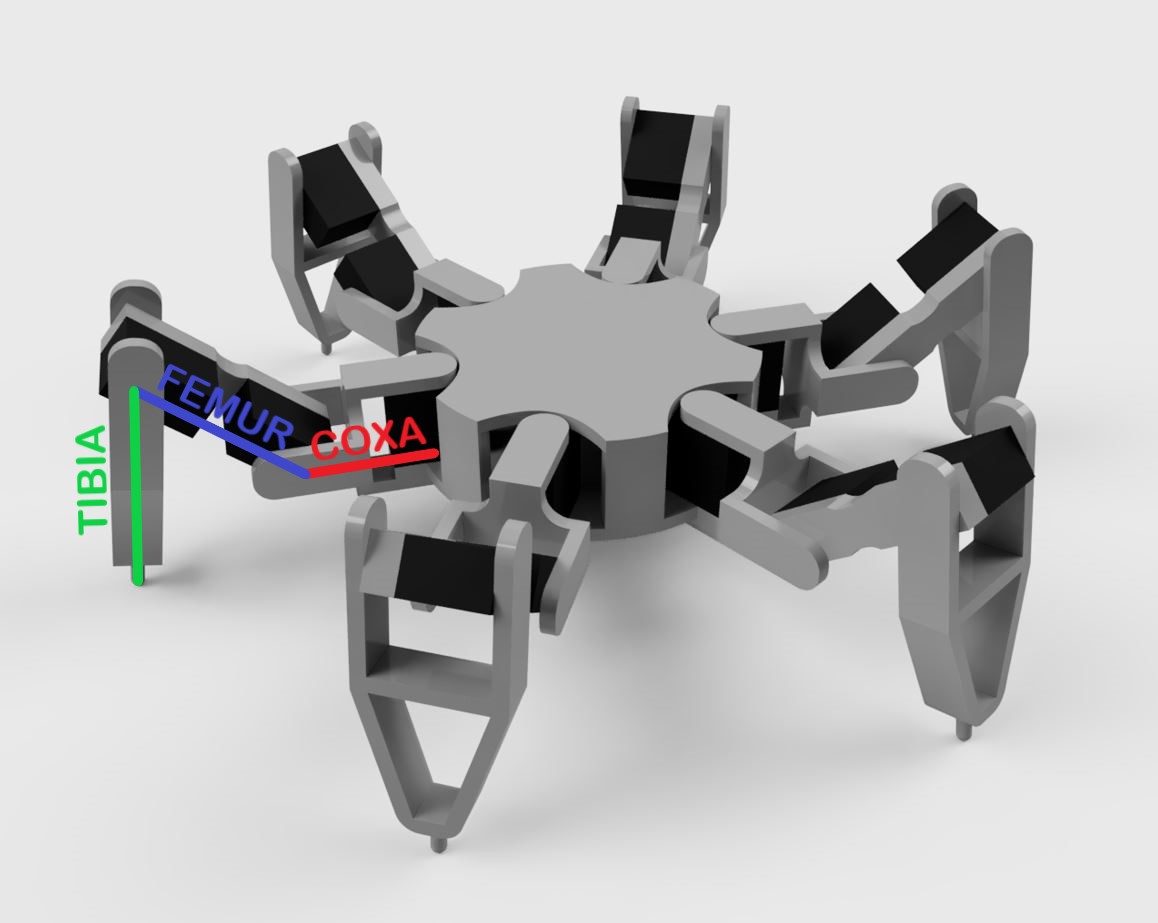
Při výpočtech budeme pracovat v souřadnicovém systému hexapoda, jehož počátek (0, 0, 0) leží ve středu jeho těla. Vstupem algoritmu inverzní kinematiky jsou požadované cílové pozice pro špičky jednotlivých nohou právě v tomto souřadnicovém systému. In the calculations, we will work in the hexapod's coordinate system, whose origin (0, 0, 0) lies at the center of its body. The input to the inverse kinematics algorithm is the desired target positions for the tips of the individual legs precisely in this coordinate system.
Prvním krokem výpočtu je aplikace posunů těla. Pokud chceme posunout tělo vůči zemi (zatímco nohy pevně stojí na podložce), z pohledu těla se posouvá samotná zem v opačném směru. Stačí tedy od koncových bodů všech nohou odečíst požadovaný vektor posunu těla. The first step of the calculation is the application of body translations. If we want to translate the body relative to the ground (while the legs stand firmly on the surface), from the body's perspective, the ground itself moves in the opposite direction. So it is sufficient to subtract the desired body translation vector from the end points of all legs.
Druhým krokem je aplikace náklonů těla, u kterých platí stejný princip. Chceme-li tělo naklonit, zatímco nohy drží pevnou pozici, z pohledu těla se zem naklání na opačnou stranu. Koncové body nohou proto přenásobíme rotačními maticemi s opačným úhlem kolem os procházejících středem hexapoda. The second step is the application of body tilts, for which the same principle applies. If we want to tilt the body while the legs hold a fixed position, from the body's perspective, the ground tilts to the opposite side. We therefore multiply the leg end points by rotation matrices with the opposite angle around axes passing through the center of the hexapod.
$$\begin{pmatrix}x_{ee} \\ y_{ee} \\ z_{ee}\end{pmatrix} = \mathbf{R_x}(-\phi) \cdot \mathbf{R_y}(-\theta) \cdot \mathbf{R_z}(-\psi) \cdot \begin{pmatrix}x_0 - t_x \\ y_0 - t_y \\ z_0 - t_z\end{pmatrix}$$
$$\mathbf{R_x}(-\phi) = \begin{pmatrix}1 & 0 & 0 \\ 0 & \cos(-\phi) & -\sin(-\phi) \\ 0 & \sin(-\phi) & \cos(-\phi)\end{pmatrix}$$
$$\mathbf{R_y}(-\theta) = \begin{pmatrix}\cos(-\theta) & 0 & \sin(-\theta) \\ 0 & 1 & 0 \\ -\sin(-\theta) & 0 & \cos(-\theta)\end{pmatrix}$$
$$\mathbf{R_z}(-\psi) = \begin{pmatrix}\cos(-\psi) & -\sin(-\psi) & 0 \\ \sin(-\psi) & \cos(-\psi) & 0 \\ 0 & 0 & 1\end{pmatrix}$$
- $x_{ee}, y_{ee}, z_{ee}$: Výsledné souřadnice špičky nohy (koncového efektoru - end effector) po zohlednění posunů a náklonů těla. $x_{ee}, y_{ee}, z_{ee}$: Resulting coordinates of the leg tip (end effector) after accounting for body translations and tilts.
- $x_0, y_0, z_0$: Původní souřadnice špičky nohy před provedením posunů a náklonů. $x_0, y_0, z_0$: Original coordinates of the leg tip before applying translations and tilts.
- $t_x, t_y, t_z$: Složky vektoru, který udává posun těla vůči zemi. $t_x, t_y, t_z$: Components of the vector that specify the body translation relative to the ground.
- $\phi, \theta, \psi$: Úhly udávající náklon těla (roll, pitch, yaw). $\phi, \theta, \psi$: Angles specifying the body tilt (roll, pitch, yaw).
- $\mathbf{R_x}(-\phi)$: Rotační matice kolem osy X o úhel $-\phi$ (roll - náklon do stran). $\mathbf{R_x}(-\phi)$: Rotation matrix around the X axis by angle $-\phi$ (roll - side-to-side tilt).
- $\mathbf{R_y}(-\theta)$: Rotační matice kolem osy Y o úhel $-\theta$ (pitch - náklon dopředu a dozadu). $\mathbf{R_y}(-\theta)$: Rotation matrix around the Y axis by angle $-\theta$ (pitch - forward and backward tilt).
- $\mathbf{R_z}(-\psi)$: Rotační matice kolem osy Z o úhel $-\psi$ (yaw - natáčení do stran). $\mathbf{R_z}(-\psi)$: Rotation matrix around the Z axis by angle $-\psi$ (yaw - turning side to side).
// Translate by (-tx,-ty,-tz) and rotate point by -yaw (psi), -pitch (theta), -roll(phi)
static inline void rotate_neg_rpy_and_translate(const float x0, const float y0, const float z0,
                                                const float t_x, const float t_y, const float t_z,
                                                const float cos_phi, const float sin_phi,
                                                const float cos_theta,  const float sin_theta,
                                                const float cos_psi, const float sin_psi,
                                                float *x_ee, float *y_ee, float *z_ee)
{
    // Translate (x0 - t_x, atd.)
    const float dx = x0 - t_x;
    const float dy = y0 - t_y;
    const float dz = z0 - t_z;

    // Rotate around z (-yaw / -psi)
    const float x1 =  dx*cos_psi + dy*sin_psi;
    const float y1 = -dx*sin_psi + dy*cos_psi;
    const float z1 =  dz;

    // Rotate around y (-pitch / -theta)
    const float x2 =  x1*cos_theta - z1*sin_theta;
    const float y2 =  y1;
    const float z2 =  x1*sin_theta + z1*cos_theta;

    // Rotate around x (-roll / -phi)
    *x_ee =  x2;
    *y_ee =  y2*cos_phi + z2*sin_phi;
    *z_ee =  y2*sin_phi - z2*cos_phi;
}
Nyní máme spočítané nové polohy nohou zohledňující posuny i náklony. Třetím krokem je samotný výpočet úhlů v jednotlivých kloubech. Zde lze postupovat podle následujících rovnic. We now have calculated new leg positions taking into account translations and tilts. The third step is the actual calculation of angles in the individual joints. Here we can proceed according to the following equations.
1. Výpočet úhlu coxa 1. Coxa angle calculation
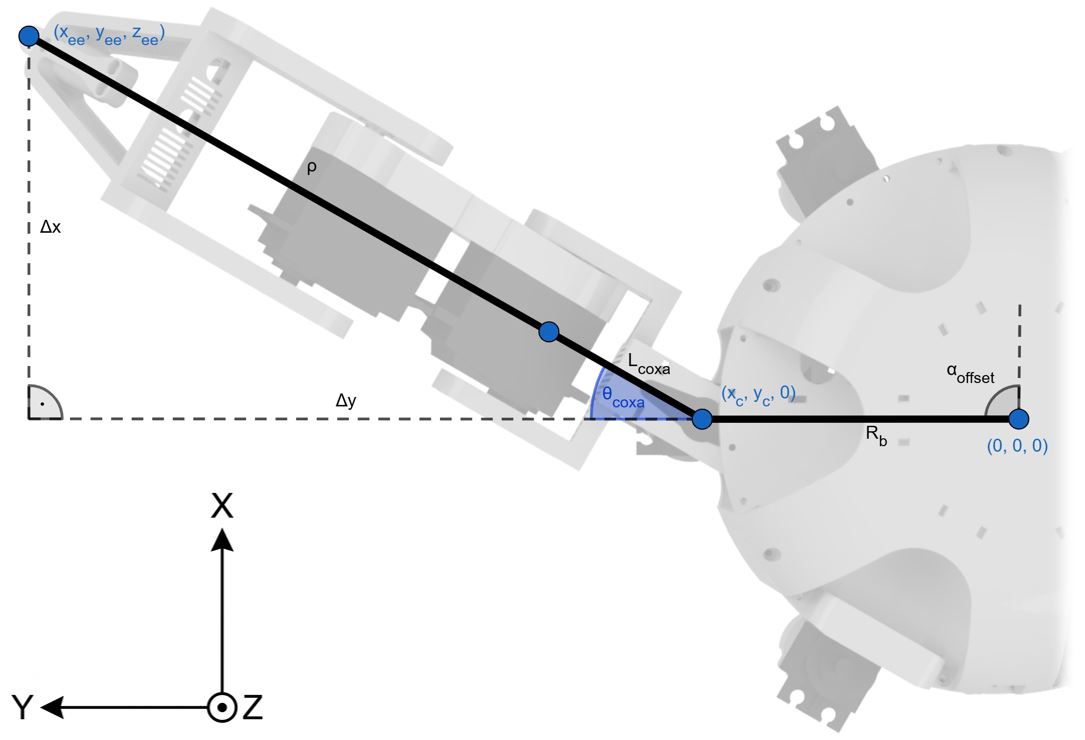
$$x_c = R_b \cdot \cos(\alpha_{offset})$$
$$y_c = R_b \cdot \sin(\alpha_{offset})$$
$$\Delta x = x_{ee} - x_c$$
$$\Delta y = y_{ee} - y_c$$
$$\boldsymbol{\theta_{coxa}} = \operatorname{atan2}(\Delta y, \Delta x) - \alpha_{offset}$$
- $x_c, y_c$: Souřadnice bodu, kde je noha uchycena k tělu robota (kloub coxa). $x_c, y_c$: Coordinates of the point where the leg is attached to the robot's body (coxa joint).
- $R_b$: Poloměr těla robota (vzdálenost od středu těla ke kloubu coxa). $R_b$: Radius of the robot's body (distance from the center of the body to the coxa joint).
- $\alpha_{offset}$: Úhlový offset konkrétní nohy vůči středové ose těla robota. $\alpha_{offset}$: Angular offset of a specific leg relative to the central axis of the robot's body.
- $x_{ee}, y_{ee}$: Požadované souřadnice špičky nohy. $x_{ee}, y_{ee}$: Desired coordinates of the leg tip.
- $\Delta x, \Delta y$: Vzdálenost mezi špičkou nohy a kloubem coxa v ose X a Y. $\Delta x, \Delta y$: Distance between the leg tip and the coxa joint in the X and Y axes.
-
$\theta_{coxa}$: Výsledný úhel natočení pro servo v prvním kloubu (coxa). Funkce
atan2vrací úhel ve správném kvadrantu. $\theta_{coxa}$: The resulting rotation angle for the servo in the first joint (coxa). Theatan2function returns the angle in the correct quadrant.
2. Výpočet úhlů femur a tibia 2. Femur and tibia angle calculation
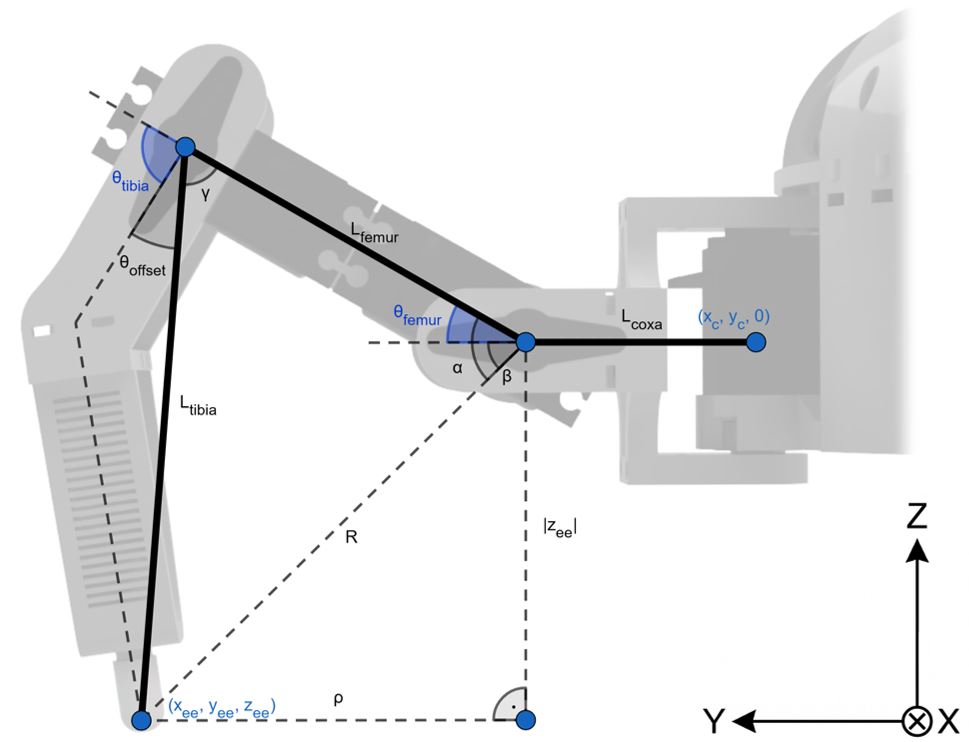
$$\rho = \sqrt{\Delta x^2 + \Delta y^2} - L_{coxa}$$
$$R = \sqrt{\rho^2 + z_{ee}^2}$$
$$\gamma = \arccos\left(\frac{L_{femur}^2 + L_{tibia}^2 - R^2}{2 \cdot L_{femur} \cdot L_{tibia}}\right)$$
$$\boldsymbol{\theta_{tibia}} = \pi - \gamma - \theta_{offset}$$
$$\alpha = \arccos\left(\frac{L_{femur}^2 + R^2 - L_{tibia}^2}{2 \cdot L_{femur} \cdot R}\right)$$
$$\beta = \operatorname{atan2}(z_{ee}, \rho)$$
$$\boldsymbol{\theta_{femur}} = \alpha - \beta$$
- $L_{coxa}, L_{femur}, L_{tibia}$: Délky jednotlivých částí nohy. $L_{coxa}, L_{femur}, L_{tibia}$: Lengths of the individual leg segments.
- $\rho$: Horizontální vzdálenost od druhého kloubu (femur) ke špičce nohy. $\rho$: Horizontal distance from the second joint (femur) to the tip of the leg.
- $z_{ee}$: Vertikální poloha špičky nohy. $z_{ee}$: Vertical position of the leg tip.
- $R$: Přímá vzdálenost od kloubu femur ke špičce nohy. $R$: Direct distance from the femur joint to the tip of the leg.
- $\gamma$: Vnitřní úhel mezi segmenty femur a tibia. $\gamma$: Internal angle between the femur and tibia segments.
- $\theta_{tibia}$: Výsledný úhel pro kloub tibia (s mechanickým offsetem $\theta_{offset}$). $\theta_{tibia}$: The resulting angle for the tibia joint (with a mechanical offset $\theta_{offset}$).
- $\alpha$: Vnitřní úhel mezi segmentem femur a pomyslnou spojnicí $R$. $\alpha$: Internal angle between the femur segment and the imaginary line $R$.
- $\beta$: Úhel zdvihu špičky nohy vůči horizontální rovině kloubu femur. $\beta$: Elevation angle of the leg tip relative to the horizontal plane of the femur joint.
- $\theta_{femur}$: Výsledný úhel pro kloub femur. $\theta_{femur}$: The resulting angle for the femur joint.
// Inverse kinematics for one leg
static bool ik_angles_from_body_target(float x_ee, float y_ee, float z_ee, int leg,
                                       float *theta_coxa_out, float *theta_femur_out, float *theta_tibia_out)
{
    // Get leg anchor point and angle
    float x_c = leg_anchor[leg].x;
    float y_c = leg_anchor[leg].y;
    float alpha_offset = leg_anchor[leg].alpha;

    // Compute coxa angle
    const float delta_x = x_ee - x_c;
    const float delta_y = y_ee - y_c;
    float theta_coxa = atan2f(delta_y, delta_x) - alpha_offset;
    theta_coxa = remainderf(theta_coxa, 2.0f*(float)M_PI); // (-pi, pi]

    // Projection
    float rho = hypotf(delta_x, delta_y) - L_COXA;
    float R = hypotf(rho, z_ee);

    // Where the robot can reach
    const float R_min = fabsf(L_FEMUR - L_TIBIA);
    const float R_max = (L_FEMUR + L_TIBIA);

    // Can it be reached?
    if (R < R_min || R > R_max || rho < 0.0f) {
        return false;
    }

    // Compute tibia angle
    float cos_gamma = (L_FEMUR*L_FEMUR + L_TIBIA*L_TIBIA - R*R) / (2.0f*L_FEMUR*L_TIBIA);
    cos_gamma = clamp(cos_gamma, -1.0f, 1.0f);
    float gamma = acosf(cos_gamma);
    float theta_tibia = (float)M_PI - gamma;

    const float theta_offset = TIBIA_ANGLE * (float)M_PI / 180.0f; // Convert tibia angle offset to radians

    theta_tibia -= theta_offset; // Apply tibia angle offset

    // Compute femur angle
    float cos_alpha = (L_FEMUR*L_FEMUR + R*R - L_TIBIA*L_TIBIA) / (2.0f*L_FEMUR * fmaxf(R, 1e-9f));
    cos_alpha = clamp(cos_alpha, -1.0f, 1.0f);
    float alpha = acosf(cos_alpha);

    float beta = atan2f(z_ee, rho);
    float theta_femur = alpha - beta;

    *theta_coxa_out = theta_coxa;
    *theta_femur_out = theta_femur;
    *theta_tibia_out = theta_tibia;
    return true;
}
Vizualizace stavu hexapoda Hexapod status visualization
Pro komunikaci mezi hexapodem a aplikací v počítači používám UDP socket. Tento protokol nevytváří trvalé spojení a nekontroluje, zda data v pořádku dorazila - paket se prostě „vystřelí“ do sítě. Pro tyto účely to však nevadí. Pokud se paket po cestě ztratí, za zlomek sekundy dorazí nový. For communication between the hexapod and the PC application, I use a UDP socket. This protocol does not create a persistent connection and does not check whether data arrived successfully - the packet is simply "fired" into the network. For these purposes, however, it does not matter. If a packet gets lost along the way, a new one will arrive in a fraction of a second.
Přenos a zpracování dat funguje v následujících krocích: Data transmission and processing work in the following steps:
-
Odesílání (Raspberry Pi): Výstupem algoritmu inverzní kinematiky jsou úhly v jednotlivých kloubech (celkem 18 hodnot). Ty se pomocí
snprintfzformátují do jednoho textového řetězce, kde jsou čísla oddělena čárkou (např.15.0,45.2,-10.1...). Tento řetězec se následně naslepo odešle na pevně nastavenou IP adresu počítače a port 5005. Sending (Raspberry Pi): The output of the inverse kinematics algorithm is the angles in individual joints (18 values in total). These are formatted usingsnprintfinto a single text string, where numbers are separated by commas (e.g.,15.0,45.2,-10.1...). This string is then blindly sent to a hardcoded PC IP address and port 5005. - Příjem (PC): Čtení dat je v aplikaci nastaveno na neblokující režim, aby program nezamrzl při čekání na zprávy. Jelikož hlavní smyčka hexapoda odesílá data s frekvencí 50 Hz, zatímco vizualizace se překresluje při 30 Hz, jsou všechna starší data ve frontě zahozena a skript použije jen nejnovější paket. Receiving (PC): Data reading in the application is set to non-blocking mode so the program does not freeze while waiting for messages. Since the hexapod's main loop sends data at a frequency of 50 Hz, while the visualization redraws at 30 Hz, all older data in the queue is discarded and the script uses only the newest packet.
-
Dekódování: Přijatá data se dekódují z bytů na text a rozdělením podle čárek (
.split(',')) z nich aplikace získá zpět seznam osmnácti úhlů. Decoding: Received data is decoded from bytes to text, and by splitting it by commas (.split(',')) the application gets back a list of eighteen angles.
Relevantní výtažky z kódu (kompletní kód je na konci stránky): Relevant code excerpts (complete code is at the bottom of the page):
#include <arpa/inet.h>
#include <sys/socket.h>
...
// Main function
int main(void) {
...
    int udp_sock = socket(AF_INET, SOCK_DGRAM, 0);
    struct sockaddr_in pc_addr;
    pc_addr.sin_family = AF_INET;
    pc_addr.sin_port = htons(5005);

    // PC local IP
    pc_addr.sin_addr.s_addr = inet_addr("xxx.xxx.x.xx");
...
    // IK Loop
    while (1) {
...
        // Send angles to PC for visualisation
        char visualisation[256];
        int len = snprintf(visualisation, sizeof(visualisation),
            "%.1f,%.1f,%.1f,%.1f,%.1f,%.1f,%.1f,%.1f,%.1f,%.1f,%.1f,%.1f,%.1f,%.1f,%.1f,%.1f,%.1f,%.1f",
            servo_angle[0][0].target_angle, servo_angle[0][1].target_angle, servo_angle[0][2].target_angle,
            servo_angle[1][0].target_angle, servo_angle[1][1].target_angle, servo_angle[1][2].target_angle,
            servo_angle[2][0].target_angle, servo_angle[2][1].target_angle, servo_angle[2][2].target_angle,
            servo_angle[3][0].target_angle, servo_angle[3][1].target_angle, servo_angle[3][2].target_angle,
            servo_angle[4][0].target_angle, servo_angle[4][1].target_angle, servo_angle[4][2].target_angle,
            servo_angle[5][0].target_angle, servo_angle[5][1].target_angle, servo_angle[5][2].target_angle
        );
        sendto(udp_sock, visualisation, len, 0, (struct sockaddr*)&pc_addr, sizeof(pc_addr));
...
    }
...
    close(udp_sock);
    return 0;
}
import socket
...
# UDP setup
UDP_IP = "0.0.0.0"
UDP_PORT = 5005
sock = socket.socket(socket.AF_INET, socket.SOCK_DGRAM)
sock.bind((UDP_IP, UDP_PORT))
sock.setblocking(False)
...
while True:
...
    # Throw away old data, process the latest
    latest_data = None
    while True:
        try:
            data, _ = sock.recvfrom(1024)
            latest_data = data
        except BlockingIOError: # Empty buffer
            break
        except Exception as e:
            print(f"Socket error: {e}")
            break

    if latest_data:
        try:
            text = latest_data.decode('utf-8').strip()
            values = list(map(float, text.split(',')))
...
        except Exception as e:
            print(f"Data processing error: {e}")
K zobrazení 3D modelu používá Python skript knihovnu VPython. Články nohou v ní reprezentuji válci a klouby koulemi. Skript následně pomocí dopředné kinematiky řetězí rotace a posuny. Tím skládá nohu dílek po dílku od těla ven směrem ke špičce. The Python script uses the VPython library to display the 3D model. I represent leg segments as cylinders and joints as spheres. The script then chains rotations and translations using forward kinematics. This assembles the leg piece by piece outwards from the body towards the tip.
import math
from vpython import *

...

# Hexapod dimensions [mm]
L_COXA = 48.0
L_FEMUR = 75.0
L_TIBIA = 112.0
BASE_RADIUS = 78.0

# 3D scene setup
scene = canvas(
    title = 'Hexapod IK Visualization',
    width = 1200,
    height = 800,
    background = color.gray(0.2),
    shadows = False
)
scene.up = vector(0, 0, 1)
scene.forward = vector(-1, -1, -1)

# Body
body = cylinder(pos = vector(0, 0, -10), axis = vector(0, 0, 20), radius = BASE_RADIUS, color = color.white, opacity = 0.8)

class Leg:
    def __init__(self, index):
        # Leg anchor position around the body
        self.alpha = math.radians(30.0 + index * 60.0)
        self.anchor_pos = vector(BASE_RADIUS * math.cos(self.alpha), BASE_RADIUS * math.sin(self.alpha), 0)

        # Leg segments and joints
        self.joint_base = sphere(pos = self.anchor_pos, radius = 8, color = color.yellow)
        self.coxa = cylinder(pos = self.anchor_pos, axis = vector(L_COXA, 0, 0), radius = 5, color = color.red)
        self.joint_femur = sphere(pos = self.coxa.pos + self.coxa.axis, radius = 6, color = color.yellow)
        self.femur = cylinder(pos = self.joint_femur.pos, axis = vector(L_FEMUR, 0, 0), radius = 4, color = color.green)
        self.joint_tibia = sphere(pos = self.femur.pos + self.femur.axis, radius = 5, color = color.yellow)
        self.tibia = cylinder(pos = self.joint_tibia.pos, axis = vector(L_TIBIA, 0, 0), radius = 3, color = color.blue)
        self.foot = sphere(pos = self.tibia.pos + self.tibia.axis, radius = 6, color = color.orange)

    def update(self, coxa_angle_deg, femur_angle_deg, tibia_angle_deg):
        t1 = math.radians(coxa_angle_deg)
        t2 = math.radians(femur_angle_deg)
        t3 = math.radians(tibia_angle_deg)

        # Coxa
        coxa_dir = vector(1, 0, 0).rotate(angle = self.alpha + t1, axis = vector(0, 0, 1))
        self.coxa.axis = coxa_dir * L_COXA

        # Femur and tibia joint axis
        joint_axis = vector(0, 0, 1).cross(coxa_dir)

        # Femur
        femur_dir = coxa_dir.rotate(angle = -t2, axis = joint_axis)
        self.joint_femur.pos = self.anchor_pos + self.coxa.axis
        self.femur.pos = self.joint_femur.pos
        self.femur.axis = femur_dir * L_FEMUR

        # Tibia
        tibia_dir = femur_dir.rotate(angle=t3, axis=joint_axis)
        self.joint_tibia.pos = self.femur.pos + self.femur.axis
        self.tibia.pos = self.joint_tibia.pos
        self.tibia.axis = tibia_dir * L_TIBIA

        self.foot.pos = self.tibia.pos + self.tibia.axis

legs = [Leg(i) for i in range(6)]

...

while True:
    rate(30)  # 30 FPS

...

            if len(values) == 18:

                # Update legs
                for i in range(6):
                    legs[i].update(values[i*3], values[i*3+1], values[i*3+2])

...
Kompletní kód projektu Complete code
Kód hexapoda: Hexapod code:
CC := gcc
CFLAGS := -Wall -Wextra -Werror -O2 -std=c99 -I. -pthread
LIBS   := -lwiringPi -lm

SRCS := main.c pca9685.c servo.c mathUtils.c motion.c vector.c bluetooth_thread.c animation.c
HEADERS := pca9685.h servo.h mathUtils.h motion.h vector.h shared.h bluetooth_thread.h animation.h

OUT := main

all: $(OUT)

$(OUT): $(SRCS) $(HEADERS)
    $(CC) $(CFLAGS) -o $@ $(SRCS) $(LIBS)

run: $(OUT)
    sudo ./$(OUT)

clean:
    rm -f $(OUT)
#pragma once

#include <stdbool.h>
#include <pthread.h>

#include "vector.h"

// Synchronization
extern pthread_mutex_t mtx;

// Global states
extern bool exit_program; // Signal to threads to exit
extern bool standing; // Is robot standing or not
extern bool animating; // Is robot in animation

// Base offsets - xyz, rpy
extern Vector3 base_offset_target_xyz; // [mm]
extern Vector3 base_offset_target_rpy; // [rad]

// Max and min parameters for offset limits
extern const float min_x_offset; extern const float max_x_offset; // [mm]
extern const float min_y_offset; extern const float max_y_offset; // [mm]
extern const float min_z_offset; extern const float max_z_offset; // [mm]
extern const float min_roll; extern const float max_roll; // [rad]
extern const float min_pitch; extern const float max_pitch; // [rad]
extern const float min_yaw; extern const float max_yaw; // [rad]
#define _POSIX_C_SOURCE 200809L
#define _DEFAULT_SOURCE // usleep

#include <stdio.h>
#include <stdlib.h>
#include <stdint.h>   // uint8_t, intptr_t
#include <stdbool.h>
#include <unistd.h>   // usleep
#include <math.h>
#include <pthread.h>  // Threads
#include <wiringPiI2C.h> // PCA9685
#include <wiringPi.h>    // GPIO

#include "pca9685.h"
#include "servo.h"
#include "mathUtils.h"
#include "motion.h"
#include "vector.h"
#include "animation.h"

#include "shared.h"
#include "bluetooth_thread.h"

#include <arpa/inet.h>
#include <sys/socket.h>

// Synchronization
pthread_mutex_t mtx = PTHREAD_MUTEX_INITIALIZER;

// Global states
bool exit_program = false;
bool standing = false; // Starting position is seated
bool animating = false; // Is animation running

// Base offsets - xyz, rpy
Vector3 base_offset_target_xyz = {0.0f, 0.0f, 0.0f};
Vector3 base_offset_target_rpy = {0.0f, 0.0f, 0.0f};

// Max and min parameters
const float min_x_offset = -70.0f; const float max_x_offset = 70.0f; // [mm]
const float min_y_offset = -70.0f; const float max_y_offset = 70.0f; // [mm]
const float min_z_offset = -80.0f; const float max_z_offset = 80.0f; // [mm]
const float min_roll = -0.3f; const float max_roll = 0.3f; // [rad]
const float min_pitch = -0.3f; const float max_pitch = 0.3f; // [rad]
const float min_yaw = -0.4f; const float max_yaw = 0.4f; // [rad]

// For smoothing changes in offsets
static const float OFFSET_SMOOTHING = 0.92f;

// Function that runs before exit
static void exit_function(void) {
    servos_safe_shutdown(); // Turn servos off without jerk
}

// Smoothly interpolate variable
static inline float smooth_var(float current, float target, float factor, float deadband) {
    if (fabsf(current - target) < deadband) {
        return target;
    }
    return factor * current + (1.0f - factor) * target;
}

// Main function
int main(void) {
    // Initialize GPIO
    if (wiringPiSetup() < 0) {
        fprintf(stderr, "ERROR: Failed to initialize GPIO.\n");
        exit(1);
    }

    // Open I2C for both PCA9685
    int fd_r = wiringPiI2CSetup(PCA_ADDR_R);
    int fd_l = wiringPiI2CSetup(PCA_ADDR_L);
    if (fd_r < 0 || fd_l < 0) {
        fprintf(stderr, "ERROR: Failed to open I2C.\n");
        exit(1);
    }

    // Initialize servos and both PCA9685
    if (servo_init(fd_r, fd_l) < 0) {
        fprintf(stderr, "ERROR: Failed to initialize servos.\n");
        exit(1);
    }

    // Initialize motion module and move to default folded position
    setup_motion();

    // Run this function before exit
    atexit(exit_function);

    // Create Bluetooth thread
    pthread_t bt_thread;
    if (pthread_create(&bt_thread, NULL, bluetooth_thread, NULL) != 0) {
        fprintf(stderr, "ERROR: Failed to create BT thread.\n");
        exit(1);
    }

    // Control loop period
    const uint64_t period_us = 20000; // 20 ms ... 50 Hz

    // Timing
    uint64_t t0 = now_us();
    uint64_t next_tick = t0 + period_us;

    // Current offsets
    Vector3 current_xyz = {0.0f, 0.0f, 0.0f};
    Vector3 current_rpy = {0.0f, 0.0f, 0.0f};

    int udp_sock = socket(AF_INET, SOCK_DGRAM, 0);
    struct sockaddr_in pc_addr;
    pc_addr.sin_family = AF_INET;
    pc_addr.sin_port = htons(5005);

    // PC local IP
    pc_addr.sin_addr.s_addr = inet_addr("xxx.xxx.x.xx");

    printf("INFO: IK control loop started (50 Hz).\n");

    // IK Loop
    while (1) {
        pthread_mutex_lock(&mtx);
        bool stop = exit_program;
        bool is_animating = animating;
        Vector3 target_xyz = base_offset_target_xyz;
        Vector3 target_rpy = base_offset_target_rpy;
        pthread_mutex_unlock(&mtx);

        if (stop) break;

        // Update IK if not animating
        if (!is_animating) {
            current_xyz.x = smooth_var(current_xyz.x, target_xyz.x, OFFSET_SMOOTHING, 0.5f);
            current_xyz.y = smooth_var(current_xyz.y, target_xyz.y, OFFSET_SMOOTHING, 0.5f);
            current_xyz.z = smooth_var(current_xyz.z, target_xyz.z, OFFSET_SMOOTHING, 0.5f);

            current_rpy.x = smooth_var(current_rpy.x, target_rpy.x, OFFSET_SMOOTHING, 0.001f);
            current_rpy.y = smooth_var(current_rpy.y, target_rpy.y, OFFSET_SMOOTHING, 0.001f);
            current_rpy.z = smooth_var(current_rpy.z, target_rpy.z, OFFSET_SMOOTHING, 0.001f);

            set_base_offset(current_xyz, current_rpy);
            inverse_kinematics();
            move_servos();
        }

        // Send angles to PC for visualisation
        char visualisation[256];
        int len = snprintf(visualisation, sizeof(visualisation),
            "%.1f,%.1f,%.1f,%.1f,%.1f,%.1f,%.1f,%.1f,%.1f,%.1f,%.1f,%.1f,%.1f,%.1f,%.1f,%.1f,%.1f,%.1f",
            servo_angle[0][0].target_angle, servo_angle[0][1].target_angle, servo_angle[0][2].target_angle,
            servo_angle[1][0].target_angle, servo_angle[1][1].target_angle, servo_angle[1][2].target_angle,
            servo_angle[2][0].target_angle, servo_angle[2][1].target_angle, servo_angle[2][2].target_angle,
            servo_angle[3][0].target_angle, servo_angle[3][1].target_angle, servo_angle[3][2].target_angle,
            servo_angle[4][0].target_angle, servo_angle[4][1].target_angle, servo_angle[4][2].target_angle,
            servo_angle[5][0].target_angle, servo_angle[5][1].target_angle, servo_angle[5][2].target_angle
        );
        sendto(udp_sock, visualisation, len, 0, (struct sockaddr*)&pc_addr, sizeof(pc_addr));

        // Sleep until next tick
        uint64_t now = now_us();
        if (now < next_tick) {
            sleep_until_us(next_tick);
            next_tick += period_us;
        } else {
            next_tick += ((now - next_tick) / period_us + 1) * period_us; // Skip missed ticks
        }
    }

    pthread_join(bt_thread, NULL);
    close(udp_sock);
    return 0;
}
#pragma once

#include <stdint.h>

typedef struct {
    // 4 joysticks, 4 potentiometers - J1X, J1Y, J2X, J2Y, P1, P2, P3, P4
    uint16_t a[8];

    // 2 joystick buttons, 3 buttons - bit0 = J1BTN, bit1 = J2BTN, bit2 = BTN1, bit3 = BTN2, bit4 = BTN3
    uint8_t buttons;
} InputPacket;

// Thread for bluetooth commands
void* bluetooth_thread(void* arg);
#include <stdio.h>
#include <stdint.h>
#include <stdbool.h>
#include <stdlib.h>
#include <string.h>
#include <errno.h>
#include <unistd.h>
#include <fcntl.h>
#include <termios.h>
#include <pthread.h>

#include "shared.h"
#include "bluetooth_thread.h"
#include "mathUtils.h"
#include "vector.h"
#include "motion.h"

// HC-05 MAC: FC:A8:FF:00:60:55

// Protocol constants
// [0xAA] [LEN] [J1X_L] [J1X_H] [J1Y_L] [J1Y_H] [J2X_L] [J2X_H] [J2Y_L] [J2Y_H]
// [P1_L] [P1_H] [P2_L] [P2_H] [P3_L] [P3_H]  [P4_L] [P4_H] [Buttons] [Checksum] - 20 bytes
#define FRAME_START 0xAA // Start byte
#define PAYLOAD_LEN 17 // 16 analog + 1 buttons = 17 bytes
#define FRAME_LEN  (1 + 1 + PAYLOAD_LEN + 1) // 20 bytes (start + len + 17 + checksum)

// Offset type - xyz/rpy
static bool offset_rpy = false;

// Previous button state
static bool js2btn_prev = false; // Base offset xyz/rpy
static bool btn2_prev = false; // Sit down/stand up
static bool btn3_prev = false; // Quit program

// Current offsets
static float x_offset = 0.0f;
static float y_offset = 0.0f;
static float z_offset = 0.0f;
static float pitch = 0.0f;
static float roll = 0.0f;
static float yaw = 0.0f;

// Change thresholds
const float offset_change_threshold = 30.0f;

// Middle of the analog value range (0 - 1023)
const float analog_middle = 512.0f;

// Where to read commands from
static const char* dev = "/dev/rfcomm0";

// Raw serial settings (binary I/O)
static void set_raw_termios(struct termios* tio) {
    tio->c_iflag &= ~(IGNBRK | BRKINT | PARMRK | ISTRIP | INLCR | IGNCR | ICRNL | IXON);
    tio->c_oflag &= ~OPOST;
    tio->c_lflag &= ~(ECHO | ECHONL | ICANON | ISIG | IEXTEN);
    tio->c_cflag &= ~(CSIZE | PARENB);
    tio->c_cflag |= CS8;
}

// Open serial
static int open_serial(const char* dev, speed_t speed) {
    int fd = open(dev, O_RDWR | O_NOCTTY); // Open file

    // Check if file is open
    if (fd < 0) {
        fprintf(stderr,"ERROR: Open(%s): %s\n", dev, strerror(errno));
        return -1;
    }

    struct termios tio;
    if (tcgetattr(fd, &tio) != 0){
        fprintf(stderr,"ERROR: Tcgetattr: %s\n", strerror(errno));
        close(fd);
        return -1;
    }

    set_raw_termios(&tio); // Set raw mode
    cfsetispeed(&tio, speed); // Set input baud
    cfsetospeed(&tio, speed); // Set output baud
    tio.c_cflag |= (CLOCAL | CREAD); // Enable RX
    tio.c_cflag &= ~CSTOPB; // 1 stop bit

    #ifdef CRTSCTS
    tio.c_cflag &= ~CRTSCTS; // No HW flow control
    #endif

    tio.c_cc[VMIN] = 0; // Return even if no byte available
    tio.c_cc[VTIME] = 1; // 0.1 s timeout

    // Apply settings
    if (tcsetattr(fd, TCSANOW, &tio) != 0) {
        fprintf(stderr,"ERROR: Tcsetattr: %s\n", strerror(errno));
        close(fd);
        return -1;
    }

    tcflush(fd, TCIOFLUSH); // Flush the serial buffer

    return fd;
}

// Sum n bytes modulo 256 for checksum
static uint8_t sum_bytes(const uint8_t* b, size_t n) {
    uint32_t s = 0;
    for (size_t i = 0; i < n; i++) s += b[i];
    return (uint8_t)(s & 0xFF);
}

// Read little-endian uint16_t from byte buffer
static uint16_t rd_u16le(const uint8_t* p) {
    return (uint16_t)(p[0] | ((uint16_t)p[1] << 8));
}

// Message handler
static void message_handler(const InputPacket* p) {
    // Decode buttons (bitfield)
    const bool js2btn = (p->buttons & (1u << 1)) != 0;  // joystick 2 push
    const bool btn2   = (p->buttons & (1u << 3)) != 0;  // BTN2 (Sit down/stand up)
    const bool btn3   = (p->buttons & (1u << 4)) != 0;  // BTN3 (Quit)

    // Get analog values
    const uint16_t j2x = p->a[3];
    const uint16_t j2y = p->a[2];
    const uint16_t pot3 = p->a[4];
    const uint16_t pot4 = p->a[5];

    // Sit down/stand up
    if (btn2 == true && btn2_prev == false) {
        pthread_mutex_lock(&mtx);
        bool is_standing = standing;
        animating = true; // Pause main 50Hz IK loop

        // Reset offsets before sitting
        if (is_standing) {
            base_offset_target_xyz = Vector3_create(0.0f, 0.0f, 0.0f);
            base_offset_target_rpy = Vector3_create(0.0f, 0.0f, 0.0f);
        }
        pthread_mutex_unlock(&mtx);

        if (is_standing) {
            printf("INFO: Sitting down.\n");
            sit_down();

            pthread_mutex_lock(&mtx);
            standing = false;
            animating = false; // Resume main loop
            pthread_mutex_unlock(&mtx);
        } else {
            printf("INFO: Standing up.\n");
            stand_up();

            pthread_mutex_lock(&mtx);
            standing = true;
            animating = false; // Resume main loop
            pthread_mutex_unlock(&mtx);
        }
    }

    // Change offset type (xyz/rpy)
    if (js2btn == true && js2btn_prev == false) {
        offset_rpy = offset_rpy ? false : true;
    }

    // Apply controller offsets
    pthread_mutex_lock(&mtx);
    if (standing && !animating) {
        // Base offset x, y, roll, pitch
        if (offset_rpy) {
            x_offset = 0.0f;
            y_offset = 0.0f;

            // Pitch
            if (fabsf(j2x - analog_middle) > offset_change_threshold) {
                pitch = lerp(min_pitch, max_pitch, (float)j2x / 1023.0f);
            } else {
                pitch = 0.0f;
            }

            // Roll
            if (fabsf(j2y - analog_middle) > offset_change_threshold) {
                roll = lerp(min_roll, max_roll, (float)j2y / 1023.0f);
            } else {
                roll = 0.0f;
            }

        } else {
            // X offset
            if (fabsf(j2x - analog_middle) > offset_change_threshold) {
                x_offset = lerp(min_x_offset, max_x_offset, (float)j2x / 1023.0f);
            } else {
                x_offset = 0.0f;
            }

            // Y offset
            if (fabsf(j2y - analog_middle) > offset_change_threshold) {
                y_offset = lerp(min_y_offset, max_y_offset, (float)j2y / 1023.0f);
            } else {
                y_offset = 0.0f;
            }

            pitch = 0.0f;
            roll = 0.0f;
        }

        // Z offset
        if (fabsf(pot3 - analog_middle) > offset_change_threshold) {
            z_offset = lerp(min_z_offset, max_z_offset, (float)pot3 / 1023.0f);
        } else {
            z_offset = 0.0f;
        }

        // Yaw
        if (fabsf(pot4 - analog_middle) > offset_change_threshold) {
            yaw = lerp(min_yaw, max_yaw, (float)pot4 / 1023.0f);
        } else {
            yaw = 0.0f;
        }

        // Apply offsets
        base_offset_target_xyz = Vector3_create(x_offset, y_offset, z_offset);
        base_offset_target_rpy = Vector3_create(roll, pitch, yaw);
    }

    // Quit program
    if (btn3 == true && btn3_prev == false) {
        exit_program = true;
    }
    pthread_mutex_unlock(&mtx);

    // Update button state
    js2btn_prev = js2btn;
    btn2_prev = btn2;
    btn3_prev = btn3;
}

// Thread for bluetooth commands
void* bluetooth_thread(void* arg) {
    (void)arg;

    // Open serial in raw
    int fd = open_serial(dev, B115200);
    if(fd < 0) return (void*)(intptr_t)-1;

    printf("INFO: Bluetooth_thread listening on %s.\n", dev);

    // Message buffer
    uint8_t buf[512];
    size_t len = 0;

    // Thread loop
    while (1) {
        pthread_mutex_lock(&mtx);
        bool stop = exit_program;
        pthread_mutex_unlock(&mtx);
        if (stop) break;

        // Read new bytes
        ssize_t n = read(fd, buf + len, sizeof(buf) - len);

        // Read errors
        if (n < 0) {
            // If read was interrupted by a signal, retry
            if (errno == EINTR) continue;
            // Otherwise report error
            fprintf(stderr, "ERROR: Read(%s): %s\n", dev, strerror(errno));
            break;
        }
        if (n == 0) {
            // TIMEOUT (no data for 0.1s)
            continue;
        }

        // N-bytes received
        len += (size_t)n;

        // Parse messages
        size_t i = 0;
        while (len - i >= FRAME_LEN) {
            while (i < len && buf[i] != FRAME_START) i++; // Find the start of a message
            if (len - i < FRAME_LEN) break; // Stop parsing if not enough bytes in the buffer

            // Verify the payload length
            if (buf[i+1] != PAYLOAD_LEN) {
                i++;
                continue;
            }

            // Verify the checksum
            uint8_t calc = sum_bytes(&buf[i], 1 + 1 + PAYLOAD_LEN);
            uint8_t rxcs = buf[i + 1 + 1 + PAYLOAD_LEN];
            if (calc != rxcs) {
                i++;
                continue;
            }

            // Parse payload
            const uint8_t* pld = &buf[i+2];
            InputPacket pkt;
            for (int k = 0; k < 8; k++) pkt.a[k] = rd_u16le(pld + k*2);
            pkt.buttons = pld[16];

            // Handle message
            message_handler(&pkt);

            i += FRAME_LEN;
        }

        // Move bytes to the beginning of the buffer
        if (i > 0) {
            size_t rest = len - i;
            if (rest) memmove(buf, buf + i, rest);
            len = rest;
        }

        // Reset the buffer if failed to find a message
        if (len > sizeof(buf) - FRAME_LEN) len = 0;
    }

    close(fd); // Close the serial
    return (void*)(intptr_t)0;
}
#pragma once

#include <stdint.h>
#include <math.h>

#include "vector.h"
#include "servo.h"

// Leg dimensions [mm]
#define L_COXA       48.0f   // Coxa length
#define L_FEMUR      75.0f   // Femur length
#define L_TIBIA     112.0f   // Tibia length
#define BASE_RADIUS  78.0f   // Distance from center to coxa joint

#define ALPHA0 (30.0f * (float)M_PI / 180.0f) // Leg 0 angle offset [rad]

// Default foot position [mm]
#define DEFAULT_DISTANCE    210.0f
#define DEFAULT_HEIGHT      -80.0f

// Initial foot position [mm]
#define INITIAL_DISTANCE 186.0f
#define INITIAL_HEIGHT -5.0f

#define GROUND_HEIGHT -28.0f

// Converts radians to degrees
#define RAD2DEG(x) ((x) * (180.0f / (float)M_PI))

void setup_motion(void); // Set default offsets, get leg anchors

void stand_up(void); // Move legs to default position
void sit_down(void); // Return legs to initial positions

// Set, change or get base (body) offset and orientation
void set_base_offset(Vector3 xyz_offset, Vector3 rpy_offset);
void change_base_offset(Vector3 xyz_offset, Vector3 rpy_offset);
void get_base_offset(Vector3 *xyz_offset, Vector3 *rpy_offset);

void get_legs_anchor(void); // Get legs anchor positions

void inverse_kinematics(void); // Compute inverse kinematics and set target angles for all legs
void set_initial_foot_targets(void); // Set target leg positions to initial
#define _POSIX_C_SOURCE 200809L
#define _DEFAULT_SOURCE // usleep

#include <math.h>
#include <stdio.h>
#include <stdint.h>
#include <unistd.h>
#include <errno.h>
#include <stdbool.h>

#include "motion.h"
#include "mathUtils.h"
#include "servo.h"
#include "vector.h"
#include "animation.h"

//----------------------------------------------------------

// Default offsets
const float default_base_offset_x = 0.0f; // Base x offset (translation) [mm]
const float default_base_offset_y = 0.0f; // Base y offset (translation) [mm]
const float default_base_offset_z = 0.0f; // Base z offset (translation) [mm]

const float default_roll = 0.0f;  // Roll [rad]
const float default_pitch = 0.0f;  // Pitch [rad]
const float default_yaw = 0.0f;  // Yaw [rad]

//----------------------------------------------------------

// Leg anchor positions and angles
static LegAnchor leg_anchor[NUM_OF_LEGS];

// For storing current offsets
static float base_offset_x;
static float base_offset_y;
static float base_offset_z;

static float roll;
static float pitch;
static float yaw;

// Sets target for all legs in distance r and height z
static inline Vector3 default_target_for_leg(int leg, float r, float z) {
    const float alpha_offset = leg_anchor[leg].alpha;
    const float x = r * cosf(alpha_offset);
    const float y = r * sinf(alpha_offset);
    return Vector3_create(x, y, z);
}

// Set initial foot target positions (relative to body center)
void set_initial_foot_targets(void)
{
    for (int leg = 0; leg < NUM_OF_LEGS; ++leg) {
        const float alpha_offset = leg_anchor[leg].alpha;
        const float r = INITIAL_DISTANCE;
        const float x = r * cosf(alpha_offset);
        const float y = r * sinf(alpha_offset);
        const float z = INITIAL_HEIGHT;

        leg_position[leg].target_position = Vector3_create(x, y, z);
        leg_position[leg].current_position = Vector3_create(x, y, z);
    }
}

void setup_motion(void) {
    // Reset offsets
    base_offset_x = default_base_offset_x;
    base_offset_y = default_base_offset_y;
    base_offset_z = default_base_offset_z;
    roll  = default_roll;
    pitch = default_pitch;
    yaw   = default_yaw;

    // Get leg anchor point
    get_legs_anchor();

    // Get default (idle standing) positions for legs
    for (int leg = 0; leg < NUM_OF_LEGS; ++leg) {
        const float alpha_offset = leg_anchor[leg].alpha;
        const float r = DEFAULT_DISTANCE;
        const float x = r * cosf(alpha_offset);
        const float y = r * sinf(alpha_offset);

        default_leg_position[leg].target_position = Vector3_create(x, y, DEFAULT_HEIGHT);
    }

    // Enable all servos
    servos_enable();

    // Mov legs to initial positions
    set_initial_foot_targets();
    inverse_kinematics();
    move_servos();

    usleep(1000000); // sleep to let servos get to position
}

void sit_down(void) {
    usleep(100000);

    // Move legs to the ground
    Vector3 end1[NUM_OF_LEGS];
    for (int l = 0; l < NUM_OF_LEGS; ++l) {
        end1[l] = Vector3_create(leg_position[l].target_position.x, leg_position[l].target_position.y, GROUND_HEIGHT);
    }
    interpolate_legs_and_offsets(end1);

    usleep(100000);

    // Move legs to initial position
    Vector3 end2[NUM_OF_LEGS];
    for (int l = 0; l < NUM_OF_LEGS; ++l) {
        end2[l] = default_target_for_leg(l, INITIAL_DISTANCE, INITIAL_HEIGHT);
    }
    interpolate_legs_and_offsets(end2);

    printf("INFO: Sitting down finished.\n");
    usleep(100000);
}

void stand_up(void) {
    usleep(100000);

    // Move legs to the ground
    Vector3 end1[NUM_OF_LEGS];
    for (int l = 0; l < NUM_OF_LEGS; ++l) {
        end1[l] = default_target_for_leg(l, DEFAULT_DISTANCE, GROUND_HEIGHT);
    }
    interpolate_legs_and_offsets(end1);

    usleep(100000);

    // Move legs to default positions
    Vector3 end2[NUM_OF_LEGS];
    for (int l = 0; l < NUM_OF_LEGS; ++l) {
        end2[l] = default_target_for_leg(l, DEFAULT_DISTANCE, DEFAULT_HEIGHT);
    }
    interpolate_legs_and_offsets(end2);

    printf("INFO: Standing up finished.\n");
    usleep(100000);
}

// Prints target positions for all legs and joints
void print_target_positions(void) {
    for (int leg = 0; leg < NUM_OF_LEGS; ++leg) {
        const Vector3 p = leg_position[leg].target_position;
        printf("Leg %d: (%.2f, %.2f, %.2f)\n", leg, p.x, p.y, p.z);
    }
}

// Prints target angles for all legs and joints
void print_target_angles(void) {
    for (int leg = 0; leg < NUM_OF_LEGS; ++leg) {
        for (int joint = 0; joint < JOINTS_PER_LEG; ++joint) {
            const float angle = servo_angle[leg][joint].target_angle;
            printf("Leg %d, Joint %d: %.2f°\n", leg, joint, angle);
        }
    }
}

// Translate by (-tx,-ty,-tz) and rotate point by -yaw (psi), -pitch (theta), -roll(phi)
static inline void rotate_neg_rpy_and_translate(const float x0, const float y0, const float z0,
                                                const float t_x, const float t_y, const float t_z,
                                                const float cos_phi, const float sin_phi,
                                                const float cos_theta,  const float sin_theta,
                                                const float cos_psi, const float sin_psi,
                                                float *x_ee, float *y_ee, float *z_ee)
{
    // Translate (x0 - t_x, atd.)
    const float dx = x0 - t_x;
    const float dy = y0 - t_y;
    const float dz = z0 - t_z;

    // Rotate around z (-yaw / -psi)
    const float x1 =  dx*cos_psi + dy*sin_psi;
    const float y1 = -dx*sin_psi + dy*cos_psi;
    const float z1 =  dz;

    // Rotate around y (-pitch / -theta)
    const float x2 =  x1*cos_theta - z1*sin_theta;
    const float y2 =  y1;
    const float z2 =  x1*sin_theta + z1*cos_theta;

    // Rotate around x (-roll / -phi)
    *x_ee =  x2;
    *y_ee =  y2*cos_phi + z2*sin_phi;
    *z_ee =  y2*sin_phi - z2*cos_phi;
}

// Compute leg anchor positions to body and angle from x axis
void get_legs_anchor() {
    for (int leg = 0; leg < NUM_OF_LEGS; ++leg) {
        leg_anchor[leg].alpha = ALPHA0 + (float)M_PI * (float)leg / 3.0f; // i * 60°
        leg_anchor[leg].x = BASE_RADIUS * cosf(leg_anchor[leg].alpha);
        leg_anchor[leg].y = BASE_RADIUS * sinf(leg_anchor[leg].alpha);
    }
}

// Inverse kinematics for one leg
static bool ik_angles_from_body_target(float x_ee, float y_ee, float z_ee, int leg,
                                       float *theta_coxa_out, float *theta_femur_out, float *theta_tibia_out)
{
    // Get leg anchor point and angle
    float x_c = leg_anchor[leg].x;
    float y_c = leg_anchor[leg].y;
    float alpha_offset = leg_anchor[leg].alpha;

    // Compute coxa angle
    const float delta_x = x_ee - x_c;
    const float delta_y = y_ee - y_c;
    float theta_coxa = atan2f(delta_y, delta_x) - alpha_offset;
    theta_coxa = remainderf(theta_coxa, 2.0f*(float)M_PI); // (-pi, pi]

    // Projection
    float rho = hypotf(delta_x, delta_y) - L_COXA;
    float R = hypotf(rho, z_ee);

    // Where the robot can reach
    const float R_min = fabsf(L_FEMUR - L_TIBIA);
    const float R_max = (L_FEMUR + L_TIBIA);

    // Can it be reached?
    if (R < R_min || R > R_max || rho < 0.0f) {
        return false;
    }

    // Compute tibia angle
    float cos_gamma = (L_FEMUR*L_FEMUR + L_TIBIA*L_TIBIA - R*R) / (2.0f*L_FEMUR*L_TIBIA);
    cos_gamma = clamp(cos_gamma, -1.0f, 1.0f);
    float gamma = acosf(cos_gamma);
    float theta_tibia = (float)M_PI - gamma;

    const float theta_offset = TIBIA_ANGLE * (float)M_PI / 180.0f; // Convert tibia angle offset to radians

    theta_tibia -= theta_offset; // Apply tibia angle offset

    // Compute femur angle
    float cos_alpha = (L_FEMUR*L_FEMUR + R*R - L_TIBIA*L_TIBIA) / (2.0f*L_FEMUR * fmaxf(R, 1e-9f));
    cos_alpha = clamp(cos_alpha, -1.0f, 1.0f);
    float alpha = acosf(cos_alpha);

    float beta = atan2f(z_ee, rho);
    float theta_femur = alpha - beta;

    *theta_coxa_out = theta_coxa;
    *theta_femur_out = theta_femur;
    *theta_tibia_out = theta_tibia;
    return true;
}

// Set base offset and orientation
void set_base_offset(Vector3 xyz_offset, Vector3 rpy_offset) {
    base_offset_x = xyz_offset.x;
    base_offset_y = xyz_offset.y;
    base_offset_z = xyz_offset.z;

    roll  = rpy_offset.x;
    pitch = rpy_offset.y;
    yaw   = rpy_offset.z;
}

// Change base offset and orientation
void change_base_offset(Vector3 xyz_offset, Vector3 rpy_offset) {
    base_offset_x += xyz_offset.x;
    base_offset_y += xyz_offset.y;
    base_offset_z += xyz_offset.z;

    roll  += rpy_offset.x;
    pitch += rpy_offset.y;
    yaw   += rpy_offset.z;
}

// Get base offset and orientation
void get_base_offset(Vector3 *xyz_offset, Vector3 *rpy_offset) {
    *xyz_offset = Vector3_create(base_offset_x, base_offset_y, base_offset_z);
    *rpy_offset = Vector3_create(roll, pitch, yaw);
}

// Computes inverse kinematics and sets target angles for all legs
void inverse_kinematics(void)
{
    // Precompute sines and cosines for rotation
    const float cos_phi = cosf(roll),   sin_phi = sinf(roll);
    const float cos_theta  = cosf(pitch), sin_theta  = sinf(pitch);
    const float cos_psi = cosf(yaw),    sin_psi = sinf(yaw);

    for (int leg = 0; leg < NUM_OF_LEGS; ++leg) {
        // Get the target foot position in body frame
        const Vector3 p0 = leg_position[leg].target_position;

        // Transform to body frame - inverse rotation + inverse translation
        float x_ee, y_ee, z_ee;
        rotate_neg_rpy_and_translate(p0.x, p0.y, p0.z,
                                     base_offset_x, base_offset_y, base_offset_z,
                                     cos_phi, sin_phi, cos_theta, sin_theta, cos_psi, sin_psi,
                                     &x_ee, &y_ee, &z_ee);

        // Inverse kinematics
        float theta_coxa, theta_femur, theta_tibia;
        const bool ok = ik_angles_from_body_target(x_ee, y_ee, z_ee, leg, &theta_coxa, &theta_femur, &theta_tibia);

        // Send warning if leg cant reach target point
        if (!ok) {
            fprintf(stderr, "WARNING: Leg %d cant reach target (%.1f, %.1f, %.1f).\n", leg, p0.x, p0.y, p0.z);
            continue;
        }

        // Set target angles in degrees
        const float theta_deg[3] = { RAD2DEG(theta_coxa), RAD2DEG(theta_femur), RAD2DEG(theta_tibia) };
        for (int j = 0; j < 3; ++j) {
            servo_angle[leg][j].target_angle = theta_deg[j];
        }
    }
}
#pragma once

#include <stdbool.h>
#include <stdint.h>

#include "vector.h"

#define NUM_OF_LEGS 6
#define JOINTS_PER_LEG 3

// Angle calibration window for linear mapping
#define CALIBRATION_MIN_ANGLE 45.0f
#define CALIBRATION_MAX_ANGLE 135.0f

#define OE_PIN 7  //PCA9685 OE pin

// Struct for servo configuration
typedef struct {
    uint8_t  pca_addr;
    uint8_t  channel;
    float    min_angle;
    float    max_angle;
    bool     inverted;
    float    angle_offset;
} ServoConfig;

// Struct for PWM calibration
typedef struct {
    int pwm_0;
    int pwm_45;
    int pwm_90;
    int pwm_135;
    int pwm_180;
} ServoCalibration;

// Struct for servo angles
typedef struct {
    float current_angle;
    float target_angle;
} ServoAngle;

// Struct for servo positions
typedef struct {
    Vector3 current_position;
    Vector3 target_position;
} LegPosition;

// Struct for leg anchor (to the body) positions
typedef struct {
    float x;
    float y;
    float alpha;
} LegAnchor;

extern const ServoConfig servo_config[NUM_OF_LEGS][JOINTS_PER_LEG]; // Servo configuration
extern ServoAngle servo_angle[NUM_OF_LEGS][JOINTS_PER_LEG]; // Current and target angles [deg]
extern LegPosition leg_position[NUM_OF_LEGS]; // Target leg positions (x, y, z) [mm]
extern LegPosition default_leg_position[NUM_OF_LEGS]; // Default leg positions (x, y, z) [mm]

int servo_init(int fd_r, int fd_l); // Initialize PCA9685 and disable servos

void servos_enable(void); // Enable all servos
void servos_disable(void); // Disable all servos
void servos_safe_shutdown(void); // Shuts down servos without final twitch

void move_servos(void); // Moves all servos to their target angles
void move_leg(int l); // Moves servos of one leg
#define _DEFAULT_SOURCE

#include <stdlib.h>
#include <stdio.h>
#include <math.h>
#include <unistd.h>
#include <wiringPi.h>
#include <wiringPiI2C.h>

#include "servo.h"
#include "pca9685.h"
#include "vector.h"
#include "motion.h"
#include "mathUtils.h"

// Prescale (50 Hz from 25 MHz)
#define PRESCALE_CONST_R 121
#define PRESCALE_CONST_L 121

// Number of calibration points
#define CAL_POINTS 5

// File descriptors for PCA9685
static int s_fd_r = -1;
static int s_fd_l = -1;

// Cache last written PWM to avoid redundant I2C writes
static int prev_pwm[NUM_OF_LEGS][JOINTS_PER_LEG];

// Servo configuration
// PCA9685 address, channel, min angle, max angle, inverted, angle offset
const ServoConfig servo_config[NUM_OF_LEGS][JOINTS_PER_LEG] = {
    // Leg 0 - L1
    {{0x40, 0, 45.0f, 145.0f, false, 90.0f}, //L11
        {0x40, 1, -20.0f, 200.0f, true, 90.0f},  //L12
        {0x40, 2, 27.0f, 200.0f, true, 0.0f}}, //L13

    // Leg 1 - L2
    {{0x40, 5, 35.0f, 145.0f, false, 90.0f}, //L21
        {0x40, 6, -20.0f, 200.0f, true, 90.0f},  //L22
        {0x40, 7, 27.0f, 200.0f, true, 0.0f}}, //L23

    // Leg 2 - L3
    {{0x40, 12, 35.0f, 135.0f, false, 90.0f}, //L31
        {0x40, 13, -20.0f, 200.0f, true, 90.0f},  //L32
        {0x40, 14, 27.0f, 200.0f, true, 0.0f}}, //L33

    // Leg 3 - P3
    {{0x41, 3, 45.0f, 145.0f, false, 90.0f}, //P31
        {0x41, 2, -20.0f, 200.0f, false, 90.0f}, //P32
        {0x41, 1, 27.0f, 200.0f, false, 0.0f}}, //P33

    // Leg 4 - P2
    {{0x41, 10, 35.0f, 145.0f, false, 90.0f}, //P21
        {0x41, 9, -20.0f, 200.0f, false, 90.0f},  //P22
        {0x41, 8, 27.0f, 200.0f, false, 0.0f}}, //P23

    // Leg 5 - P1
    {{0x41, 15, 35.0f, 135.0f, false, 90.0f}, //P11
        {0x41, 14, -20.0f, 200.0f, false, 90.0f}, //P12
        {0x41, 13, 27.0f, 200.0f, false, 0.0f}}  //P13
};

// Calibration angles [deg]
static const float kCalAnglesDeg[5] = {0.f, 45.f, 90.f, 135.f, 180.f};

// Servo calibration PWM values at 0, 45, 90, 135, 180 deg
static const float servo_calibration[NUM_OF_LEGS][JOINTS_PER_LEG][CAL_POINTS] = {
    // Leg 0 - L1
    {
        {119.f, 208.f, 307.f, 403.f, 504.f}, // L11
        {114.f, 212.f, 315.f, 420.f, 521.f}, // L12
        {109.f, 205.f, 308.f, 406.f, 501.f}  // L13
    },

    // Leg 1 - L2
    {
        {115.f, 210.f, 311.f, 411.f, 508.f}, // L21
        {104.f, 206.f, 313.f, 417.f, 514.f}, // L22
        {112.f, 206.f, 310.f, 414.f, 510.f}  // L23
    },

    // Leg 2 - L3
    {
        {110.f, 205.f, 310.f, 415.f, 511.f}, // L31
        {104.f, 206.f, 315.f, 418.f, 515.f}, // L32
        { 98.f, 191.f, 293.f, 397.f, 493.f}  // L33
    },

    // Leg 3 - P3
    {
        {109.f, 201.f, 299.f, 395.f, 490.f}, // P31
        { 96.f, 196.f, 298.f, 400.f, 496.f}, // P32
        {104.f, 197.f, 293.f, 390.f, 490.f}  // P33
    },

    // Leg 4 - P2
    {
        {106.f, 200.f, 300.f, 398.f, 494.f}, // P21
        {111.f, 211.f, 310.f, 412.f, 508.f}, // P22
        {102.f, 195.f, 295.f, 394.f, 489.f}  // P23
    },

    // Leg 5 - P1
    {
        {111.f, 203.f, 300.f, 399.f, 494.f}, // P11
        {100.f, 200.f, 301.f, 402.f, 500.f}, // P12
        {118.f, 207.f, 307.f, 403.f, 502.f}  // P13
    }
};

ServoAngle servo_angle[NUM_OF_LEGS][JOINTS_PER_LEG]; // Current and target servo positions
LegPosition leg_position[NUM_OF_LEGS]; // Target leg end effector positions
LegPosition default_leg_position[NUM_OF_LEGS]; // Default leg end effector positions

// Map angle to [pwm_min, pwm_max] linearly
static inline int lin_angle_to_pwm(float angle, int pwm_min, int pwm_max) {
    const float span = (float)(pwm_max - pwm_min);
    const float t = (angle - CALIBRATION_MIN_ANGLE) / (CALIBRATION_MAX_ANGLE - CALIBRATION_MIN_ANGLE);
    const float v = (float)pwm_min + t * span;
    return (int)lroundf(v);
}

// Map angle to [pwm_min, pwm_max] using all calibration values lineraly per partes
static inline int angle_to_pwm(float angle, int leg, int joint) {
    if (angle == 0.0f)   return (int)lroundf(servo_calibration[leg][joint][0]);
    if (angle == 180.0f) return (int)lroundf(servo_calibration[leg][joint][4]);

    int i = (int)(angle / 45.0f);
    if (i < 0) i = 0;
    if (i > 3) i = 3;
    float t = (angle - kCalAnglesDeg[i]) / 45.0f;

    const float *p = servo_calibration[leg][joint];
    float v = lerp(p[i], p[i+1], t);
    return (int)lroundf(v);
}

// Initialize PCA9685 and disable servos
int servo_init(int fd_r, int fd_l) {
    s_fd_r = fd_r;
    s_fd_l = fd_l;

    pinMode(OE_PIN, OUTPUT);
    digitalWrite(OE_PIN, HIGH);

    // Reset cache
    for (int l = 0; l < NUM_OF_LEGS; ++l)
        for (int j = 0; j < JOINTS_PER_LEG; ++j)
            prev_pwm[l][j] = -1;

    if (pca9685_init(s_fd_r, PRESCALE_CONST_R) < 0 || pca9685_init(s_fd_l, PRESCALE_CONST_L) < 0) {
        return -1;
    }

    return 0;
}

// Enable all servos
inline void servos_enable(void)  {
    digitalWrite(OE_PIN, LOW);
}

// Disable all servos
inline void servos_disable(void) {
    digitalWrite(OE_PIN, HIGH);
}

//
void servos_safe_shutdown(void) {
    // FULL OFF (no pulse)
    for (int l = 0; l < NUM_OF_LEGS; ++l) {
        for (int j = 0; j < JOINTS_PER_LEG; ++j) {
            const ServoConfig *cfg = &servo_config[l][j];
            int fd = (cfg->pca_addr == PCA_ADDR_R) ? s_fd_r : s_fd_l;
            pca9685_channel_full_off(fd, cfg->channel);
        }
    }

    // Sleep
    pca9685_sleep(s_fd_r);
    pca9685_sleep(s_fd_l);

    // Disable all servos
    servos_disable();
}

// Sets angle to servo
static inline void set_servo_angle(int l, int j) {
    const ServoConfig *cfg = &servo_config[l][j];
    float a = servo_angle[l][j].target_angle + (float)cfg->angle_offset;
    if (cfg->inverted) {
        a = 180.0f - a;
    }

    // Check servo angle limits
    if (a < cfg->min_angle || a > cfg->max_angle) {
        //printf("WARNING: Servo limit reached. Leg: %d, Joint: %d, Angle: %.1f\n", l, j, a);
        a = clamp(a, cfg->min_angle, cfg->max_angle);
    }

    int pwm = angle_to_pwm(a, l, j);
    int fd = (cfg->pca_addr == PCA_ADDR_R) ? s_fd_r : s_fd_l;

    // Set pwm only if value changed
    if (pwm != prev_pwm[l][j]) {
        pca9685_set_pwm(fd, cfg->channel, 0, pwm);
        prev_pwm[l][j] = pwm;
    }
}

// Moves all servos to their target angles
void move_servos(void) {
    for (int l = 0; l < NUM_OF_LEGS; ++l) {
        for (int j = 0; j < JOINTS_PER_LEG; ++j) {
            set_servo_angle(l, j);
        }
    }
}

// Moves servos of one leg
void move_leg(int l) {
    for (int j = 0; j < JOINTS_PER_LEG; ++j) {
        set_servo_angle(l, j);
    }
}
#pragma once

#include <stdint.h>

// PCA9685 I2C addresses
#define PCA_ADDR_R  0x40
#define PCA_ADDR_L  0x41

int  pca9685_init(int fd, int prescale_val); // Initialize PCA9685

// Write a single channel's ON/OFF 12-bit timings
void pca9685_set_pwm(int fd, int channel, int on, int off);

void pca9685_sleep(int fd); // Put PCA9685 to sleep
void pca9685_wake(int fd); // Wake PCA9685 up from sleep
void pca9685_channel_full_off(int fd, int channel); // Sets LEDx_OFF_H bit4 - FULL OFF
#define _DEFAULT_SOURCE

#include <unistd.h>
#include <wiringPiI2C.h>
#include <stdint.h>
#include <stdio.h>

#include "pca9685.h"

// registers
enum { MODE1 = 0x00, MODE2 = 0x01, PRESCALE = 0xFE, LED0_ON_L = 0x06 };
enum { MODE1_RESTART = 0x80, MODE1_AI = 0x20, MODE1_SLEEP = 0x10 };
enum { MODE2_OCH = 0x08, MODE2_OUTDRV = 0x04 };

// Initialize PCA9685
int pca9685_init(int fd, int prescale_val) {
    // MODE2: push-pull outputs + update on STOP for glitch-free multi-write
    if (wiringPiI2CWriteReg8(fd, MODE2, MODE2_OUTDRV | MODE2_OCH) < 0) {
        return -1;
    }

    // Sleep to allow prescale update
    uint8_t mode1 = wiringPiI2CReadReg8(fd, MODE1);
    if (wiringPiI2CWriteReg8(fd, MODE1, (mode1 & ~MODE1_RESTART) | MODE1_SLEEP) < 0) {
        return -1;
    }
    usleep(500);

    // Set frequency prescaler
    if (wiringPiI2CWriteReg8(fd, PRESCALE, prescale_val) < 0) {
        return -1;
    }
    usleep(500);

    // Wake up, enable auto-increment
    mode1 = (mode1 & ~MODE1_SLEEP) | MODE1_AI;
    if (wiringPiI2CWriteReg8(fd, MODE1, mode1) < 0) {
        return -1;
    }
    usleep(500);

    // Restart to apply settings
    if (wiringPiI2CWriteReg8(fd, MODE1, mode1 | MODE1_RESTART) < 0) {
        return -1;
    }
    usleep(500);

    return 0;
}

// Write a single channel's ON/OFF 12-bit timings
void pca9685_set_pwm(int fd, int channel, int on, int off) {
    int base = LED0_ON_L + 4 * channel;

    uint8_t buffer[5];

    buffer[0] = base;
    buffer[1] = on & 0xFF;         // LEDx_ON_L
    buffer[2] = (on >> 8) & 0x0F;  // LEDx_ON_H
    buffer[3] = off & 0xFF;        // LEDx_OFF_L
    buffer[4] = (off >> 8) & 0x0F; // LEDx_OFF_H

    if (write(fd, buffer, 5) != 5) {
        fprintf(stderr, "ERROR: I2C write failed for channel %d\n", channel);
    }
}

// Put PCA9685 to sleep
void pca9685_sleep(int fd) {
    uint8_t mode1 = (uint8_t)wiringPiI2CReadReg8(fd, MODE1);
    wiringPiI2CWriteReg8(fd, MODE1, mode1 | MODE1_SLEEP);
}

// Wake PCA9685 up from sleep
void pca9685_wake(int fd) {
    uint8_t mode1 = wiringPiI2CReadReg8(fd, MODE1);
    mode1 = (mode1 & ~MODE1_SLEEP) | MODE1_AI;
    wiringPiI2CWriteReg8(fd, MODE1, mode1);
    usleep(500);
    wiringPiI2CWriteReg8(fd, MODE1, mode1 | MODE1_RESTART);
}

// Sets LEDx_OFF_H bit4 (FULL OFF)
void pca9685_channel_full_off(int fd, int channel) {
    int base = LED0_ON_L + 4 * channel;
    uint8_t buffer[5];

    buffer[0] = base;
    buffer[1] = 0x00; // LEDx_ON_L
    buffer[2] = 0x00; // LEDx_ON_H
    buffer[3] = 0x00; // LEDx_OFF_L
    buffer[4] = 0x10; // LEDx_OFF_H (bit 4 = FULL OFF)

    if (write(fd, buffer, 5) != 5) {
        fprintf(stderr, "ERROR: I2C write failed for channel %d\n", channel);
    }
}
#pragma once

#include <stdint.h>
#include "vector.h"
#include "servo.h"

uint64_t now_us(void); // Get current time in microseconds
void sleep_until_us(uint64_t target_us); // Absolute sleep, retries on EINTR

// Interpolates legs positions using polynom
void interpolate_legs_and_offsets(const Vector3 end_targets[NUM_OF_LEGS]);
#define _POSIX_C_SOURCE 200809L
#define _DEFAULT_SOURCE // usleep

#include <time.h>
#include <unistd.h>
#include <errno.h>

#include "animation.h"
#include "motion.h"
#include "vector.h"
#include "mathUtils.h"
#include "shared.h"

// Animation parameters
const double animation_dur = 1.5; // [s]
static const int animation_pol_deg = 7;

// Get current time in microseconds
uint64_t now_us(void) {
    struct timespec ts;
    clock_gettime(CLOCK_MONOTONIC, &ts);
    return (uint64_t)ts.tv_sec * 1000000ull + (uint64_t)(ts.tv_nsec / 1000ull);
}

// Absolute sleep, retries on EINTR
void sleep_until_us(uint64_t target_us) {
    struct timespec ts;
    ts.tv_sec  = (time_t)(target_us / 1000000ull);
    ts.tv_nsec = (long)((target_us % 1000000ull) * 1000ull);
    for (;;) {
        int rc = clock_nanosleep(CLOCK_MONOTONIC, TIMER_ABSTIME, &ts, NULL);
        if (rc == 0) break;
        if (rc != EINTR) break; // Interrupted by signal - exit
    }
}

void interpolate_legs_and_offsets(const Vector3 end_targets[NUM_OF_LEGS]) {
    // Timing
    const int SERVO_UPDATE_HZ = 50;
    const uint64_t period_us  = 1000000ull / SERVO_UPDATE_HZ;
    uint64_t t0 = now_us();
    uint64_t next_tick = t0 + period_us;
    float t_normalised = 0.0f;

    // Get starting positions
    Vector3 start[NUM_OF_LEGS];
    for (int l = 0; l < NUM_OF_LEGS; ++l) {
        start[l] = leg_position[l].target_position;
    }

    while (t_normalised < 1.0f) {
        uint64_t now = now_us();
        t_normalised = (float)((now - t0) * 1e-6f) / (float)animation_dur;
        if (t_normalised > 1.0f) t_normalised = 1.0f;

        // Get new leg positions
        for (int l = 0; l < NUM_OF_LEGS; ++l) {
            Vector3 xyz = Vector3_create(
                smooth_interpolation(start[l].x, end_targets[l].x, t_normalised, animation_pol_deg),
                smooth_interpolation(start[l].y, end_targets[l].y, t_normalised, animation_pol_deg),
                smooth_interpolation(start[l].z, end_targets[l].z, t_normalised, animation_pol_deg)
            );
            leg_position[l].target_position = xyz;
            leg_position[l].current_position = xyz;
        }

        // Compute IK and move servos
        inverse_kinematics();
        move_servos();

        // Timing
        if (now < next_tick) {
            sleep_until_us(next_tick);
            next_tick += period_us;
        } else {
            uint64_t behind = now - next_tick;
            next_tick += ((behind / period_us) + 1) * period_us;
        }
    }
}
#pragma once

#include <math.h>

#ifndef M_PI
#define M_PI 3.14159265358979323846
#endif

// Linear interpolation
float lerp(float a, float b, float t);

// Constrain value between min and max
float clamp(float value, float min, float max);

// Evaluate polynomial using Horner's method
float poly_horner(const float *coeffs, int deg, float x);

// Interpolates between start and end using polynomial
float smooth_interpolation(float start, float end, float t, int deg);
#include <stdio.h>
#include <stdlib.h>
#include <math.h>

#include "mathUtils.h"

// 5th degree polynomial
static const float polynom5[] = {0.0f, 0.0f, 0.0f, 10.0f, -15.0f, 6.0f};
static const int polynom5_deg = sizeof(polynom5)/sizeof(polynom5[0]) - 1;

// 7th degree polynomial
static const float polynom7[] = {0.0f, 0.0f, 0.0f, 0.0f, 35.0f, -84.0f, 70.0f, -20.0f};
static const int polynom7_deg = sizeof(polynom7)/sizeof(polynom7[0]) - 1;

// Linear interpolation
float lerp(float a, float b, float t) {
    return a + (b - a) * t;
}

// Constrain value between min and max
float clamp(float value, float min, float max) {
    return fmaxf(min, fminf(max, value));
}

// Evaluate polynomial using Horner's method
float poly_horner(const float *coeffs, int deg, float x) {
    float result = 0.0f;
    for (int i = deg; i >= 0; --i) {
        result = fmaf(result, x, coeffs[i]);
    }
    return result;
}

// Interpolates between start and end using polynomial easing
float smooth_interpolation(float start, float end, float t, int deg) {
    float t_ease;

    switch (deg) {
        case 7:
            t_ease = poly_horner(polynom7, polynom7_deg, t);
            break;
        case 5:
            t_ease = poly_horner(polynom5, polynom5_deg, t);
            break;
        default:
            fprintf(stderr, "ERROR: %dth degree polynomial not supported.\n", deg);
            exit(-1);
    }

    t_ease = clamp(t_ease, 0.0f, 1.0f);
    return lerp(start, end, t_ease);
}
#pragma once

typedef struct {
    float x;
    float y;
    float z;
} Vector3;

Vector3 Vector3_create(float x, float y, float z); // Creates vector
Vector3 Vector3_add(Vector3 a, Vector3 b); // Adds two vectors
Vector3 Vector3_sub(Vector3 a, Vector3 b); // Subtracts vector b from a
Vector3 Vector3_scale(Vector3 v, float s); // Scales vector by a scalar
#include "vector.h"

// Creates Vector3
Vector3 Vector3_create(float x, float y, float z) {
    Vector3 v = {x, y, z};
    return v;
}

// Adds two vectors
Vector3 Vector3_add(Vector3 a, Vector3 b) {
    return Vector3_create(a.x + b.x, a.y + b.y, a.z + b.z);
}

// Subtracts vector b from a
Vector3 Vector3_sub(Vector3 a, Vector3 b) {
    return Vector3_create(a.x - b.x, a.y - b.y, a.z - b.z);
}

// Scales vector by a scalar
Vector3 Vector3_scale(Vector3 v, float s) {
    return Vector3_create(v.x * s, v.y * s, v.z * s);
}
Kód dálkového ovládání: Remote control code:
#include <U8g2lib.h> // OLED
#include <Wire.h>    // I2C

// Display object
U8G2_SH1106_128X64_NONAME_F_HW_I2C u8g2(U8G2_R0, /* reset=*/ U8X8_PIN_NONE);

// Button pins
const int pinSW1 = 27;
const int pinSW2 = 5;
const int pinSW3 = 3;

// Potentiometer pins
const int pinRV1 = A0;
const int pinRV2 = A1;
const int pinRV3 = A14;
const int pinRV4 = A12;

// Left joystick
const int joy1X = A10;
const int joy1Y = A8;
const int joy1Btn = A6;

// Right joystick
const int joy2X = A7;
const int joy2Y = A5;
const int joy2Btn = A3;

// Timing
constexpr float FREQ = 50.0f;
volatile bool sample_due = false;

const float EMA_ALPHA = 0.30f;

// Setup Timer1 for CTC mode
void setupTimer1CTC(float hz) {
    const uint16_t presc_vals[5] = {1,8,64,256,1024};
    const uint16_t presc_bits[5] = {_BV(CS10), _BV(CS11), _BV(CS11)|_BV(CS10), _BV(CS12), _BV(CS12)|_BV(CS10)};

    uint16_t chosen = 0; uint32_t ocr = 0;
    for(int i = 0;i < 5; i++){
    ocr = (uint32_t)(F_CPU/(presc_vals[i]*hz)) - 1U;
    if (ocr <= 65535U && ocr >= 1U) {
        chosen = presc_bits[i];
        break;
    }
    }

    if (!chosen) {
    uint32_t t = (uint32_t)(F_CPU/(1024.0*hz)) - 1U;
    if (t > 65535U) t = 65535U;
    ocr = t;
    chosen = _BV(CS12)| _BV(CS10);
    }

    noInterrupts();
    TCCR1A = 0;
    TCCR1B = 0;
    TCNT1 = 0;
    OCR1A = (uint16_t)ocr;
    TCCR1B |= _BV(WGM12) | chosen;
    TIMSK1 |= _BV(OCIE1A);
    interrupts();
}

// Timer interrupt
ISR(TIMER1_COMPA_vect) {
    sample_due = true;
}

// Send data frame
static inline void sendFrameHW(const uint16_t v[8], uint8_t buttons) {
    const uint8_t LEN = 8*2 + 1; // Payload length
    uint8_t sum = 0; // Checksum

    auto put = [&](uint8_t b ){
    Serial3.write(b);
    sum = (uint8_t)(sum + b);
    };

    put(0xAA); // Start byte
    put(LEN);  // Data length

    for (int i = 0; i < 8; i++) {
    put((uint8_t)(v[i] & 0xFF)); // Low byte
    put((uint8_t)(v[i] >> 8));   // High byte
    }

    put(buttons);

    Serial3.write(sum);
}

void setup() {
    Serial.begin(115200);
    Serial3.begin(115200);
    delay(50);

    pinMode(pinSW1, INPUT_PULLUP);
    pinMode(pinSW2, INPUT_PULLUP);
    pinMode(pinSW3, INPUT_PULLUP);
    pinMode(joy1Btn, INPUT_PULLUP);
    pinMode(joy2Btn, INPUT_PULLUP);

    u8g2.setBusClock(400000); // Fast I2C
    u8g2.begin();

    setupTimer1CTC(FREQ);
}

void loop() {
    // Store display values between cycles
    static int drawJ1X = 20, drawJ1Y = 32, drawJ2X = 106, drawJ2Y = 32;
    static int h1 = 0, h2 = 0, h3 = 0, h4 = 0;
    static bool btn1 = false, btn2 = false, btn3 = false;
    static bool j1Btn = false, j2Btn = false;

    // Store smoothed potentiometer values
    static float smoothRV1 = -1.0f;
    static float smoothRV2 = -1.0f;
    static float smoothRV3 = -1.0f;
    static float smoothRV4 = -1.0f;

    bool due;
    noInterrupts();
    due = sample_due;
    if (due) sample_due = false; // Reset if true
    interrupts();

    // Read inputs and send using Bluetooth
    if (due) {
    // Read values
    int rawRV1 = analogRead(pinRV1);
    int rawRV2 = analogRead(pinRV2);
    int rawRV3 = 1023 - analogRead(pinRV3);
    int rawRV4 = analogRead(pinRV4);

    // Initialize first read
    if (smoothRV1 < 0.0f) {
        smoothRV1 = rawRV1;
        smoothRV2 = rawRV2;
        smoothRV3 = rawRV3;
        smoothRV4 = rawRV4;
    } else {
        // EMA smoothing
        smoothRV1 = (EMA_ALPHA * rawRV1) + ((1.0f - EMA_ALPHA) * smoothRV1);
        smoothRV2 = (EMA_ALPHA * rawRV2) + ((1.0f - EMA_ALPHA) * smoothRV2);
        smoothRV3 = (EMA_ALPHA * rawRV3) + ((1.0f - EMA_ALPHA) * smoothRV3);
        smoothRV4 = (EMA_ALPHA * rawRV4) + ((1.0f - EMA_ALPHA) * smoothRV4);
    }

    // Convert to integers
    unsigned int valRV1 = (unsigned int)smoothRV1;
    unsigned int valRV2 = (unsigned int)smoothRV2;
    unsigned int valRV3 = (unsigned int)smoothRV3;
    unsigned int valRV4 = (unsigned int)smoothRV4;

    // Convert values to pixels
    h1 = (valRV1 * 36) >> 10;
    h2 = (valRV2 * 36) >> 10;
    h3 = (valRV3 * 36) >> 10;
    h4 = (valRV4 * 36) >> 10;

    // Read button presses
    btn1 = !digitalRead(pinSW1);
    btn2 = !digitalRead(pinSW2);
    btn3 = !digitalRead(pinSW3);
    j1Btn = !digitalRead(joy1Btn);
    j2Btn = !digitalRead(joy2Btn);

    // Invert Joy 1 axes
    long dX1 = 512 - analogRead(joy1X);
    long dY1 = 512 - analogRead(joy1Y);
    long distSq1 = dX1 * dX1 + dY1 * dY1;

    if (distSq1 > 40000L) j1Btn = false;
    if (distSq1 > 262144L) {
        long dist1 = sqrt(distSq1);
        dX1 = (dX1 * 512) / dist1;
        dY1 = (dY1 * 512) / dist1;
    }

    drawJ1X = 20 + (dX1 / 32);
    drawJ1Y = 32 + (dY1 / 32);

    // Normal Joy 2 axes
    long dX2 = analogRead(joy2X) - 512;
    long dY2 = analogRead(joy2Y) - 512;
    long baseDistSq2 = dX2 * dX2 + dY2 * dY2;

    if (baseDistSq2 > 40000L) j2Btn = false;

    long distSq2 = dX2 * dX2 + dY2 * dY2;
    if (distSq2 > 262144L) {
        long dist2 = sqrt(distSq2);
        dX2 = (dX2 * 512) / dist2;
        dY2 = (dY2 * 512) / dist2;
    }

    drawJ2X = 106 + (dX2 / 32);
    drawJ2Y = 32 + (dY2 / 32);

    // Prepare data for Bluetooth
    uint16_t v[8];
    v[0] = (uint16_t) constrain(dX1 + 512, 0, 1023);
    v[1] = (uint16_t) constrain(dY1 + 512, 0, 1023);
    v[2] = (uint16_t) constrain(dX2 + 512, 0, 1023);
    v[3] = (uint16_t) constrain(dY2 + 512, 0, 1023);
    v[4] = valRV1;
    v[5] = valRV2;
    v[6] = valRV3;
    v[7] = valRV4;

    uint8_t buttons = 0;
    if (j1Btn) buttons |= (1 << 0);
    if (j2Btn) buttons |= (1 << 1);
    if (btn1)  buttons |= (1 << 2);
    if (btn2)  buttons |= (1 << 3);
    if (btn3)  buttons |= (1 << 4);

    sendFrameHW(v, buttons);
    }

    static uint32_t last = 0;
    uint32_t now = millis();

    if (now - last >= 35) { // 35 ms delay = ~28 FPS
    last = now;

    u8g2.clearBuffer(); // Clear display buffer

    // Outlines for joysticks
    u8g2.drawCircle(20, 32, 20);
    u8g2.drawCircle(106, 32, 20);

    // Left joystick dot
    if (j1Btn) u8g2.drawDisc(drawJ1X, drawJ1Y, 4);
    else u8g2.drawCircle(drawJ1X, drawJ1Y, 4);

    // Right joystick dot
    if (j2Btn) u8g2.drawDisc(drawJ2X, drawJ2Y, 4);
    else u8g2.drawCircle(drawJ2X, drawJ2Y, 4);

    // Graph frames
    u8g2.drawFrame(46, 27, 6, 36);
    u8g2.drawFrame(56, 27, 6, 36);
    u8g2.drawFrame(66, 27, 6, 36);
    u8g2.drawFrame(76, 27, 6, 36);

    // Graph bars
    u8g2.drawBox(46, 63 - h4, 6, h4); // RV4 bar
    u8g2.drawBox(56, 63 - h3, 6, h3); // RV3 bar
    u8g2.drawBox(66, 63 - h1, 6, h1); // RV1 bar
    u8g2.drawBox(76, 63 - h2, 6, h2); // RV2 bar

    // Top buttons
    if (btn1) u8g2.drawDisc(51, 8, 4); else u8g2.drawCircle(51, 8, 4);
    if (btn2) u8g2.drawDisc(64, 8, 4); else u8g2.drawCircle(64, 8, 4);
    if (btn3) u8g2.drawDisc(77, 8, 4); else u8g2.drawCircle(77, 8, 4);

    u8g2.sendBuffer(); // Send buffer to display
    }
}
Kód vizualizační aplikace: Visualization app code:
import socket
import math
from vpython import *

# UDP setup
UDP_IP = "0.0.0.0"
UDP_PORT = 5005
sock = socket.socket(socket.AF_INET, socket.SOCK_DGRAM)
sock.bind((UDP_IP, UDP_PORT))
sock.setblocking(False)

# Hexapod dimensions [mm]
L_COXA = 48.0
L_FEMUR = 75.0
L_TIBIA = 112.0
BASE_RADIUS = 78.0

# 3D scene setup
scene = canvas(
    title = 'Hexapod inverse kinematics visualisation',
    width = 1200,
    height = 800,
    background = color.gray(0.2),
    shadows = False
)
scene.up = vector(0, 0, 1)
scene.forward = vector(-1, -1, -1)

# Body
body = cylinder(pos = vector(0, 0, -10), axis = vector(0, 0, 20), radius = BASE_RADIUS,
color = color.white, opacity = 0.8)

class Leg:
    def __init__(self, index):
        # Leg anchor position around the body
        self.alpha = math.radians(30.0 + index * 60.0)
        self.anchor_pos = vector(BASE_RADIUS * math.cos(self.alpha), BASE_RADIUS * math.sin(self.alpha), 0)

        # Leg segments and joints
        self.joint_base = sphere(pos = self.anchor_pos, radius = 8, color = color.yellow)
        self.coxa = cylinder(pos = self.anchor_pos, axis = vector(L_COXA, 0, 0), radius = 5, color = color.red)
        self.joint_femur = sphere(pos = self.coxa.pos + self.coxa.axis, radius = 6, color = color.yellow)
        self.femur = cylinder(pos = self.joint_femur.pos, axis = vector(L_FEMUR, 0, 0), radius = 4, color = color.green)
        self.joint_tibia = sphere(pos = self.femur.pos + self.femur.axis, radius = 5, color = color.yellow)
        self.tibia = cylinder(pos = self.joint_tibia.pos, axis = vector(L_TIBIA, 0, 0), radius = 3, color = color.blue)
        self.foot = sphere(pos = self.tibia.pos + self.tibia.axis, radius = 6, color = color.orange)

    def update(self, coxa_angle_deg, femur_angle_deg, tibia_angle_deg):
        t1 = math.radians(coxa_angle_deg)
        t2 = math.radians(femur_angle_deg)
        t3 = math.radians(tibia_angle_deg)

        # Coxa
        coxa_dir = vector(1, 0, 0).rotate(angle = self.alpha + t1, axis = vector(0, 0, 1))
        self.coxa.axis = coxa_dir * L_COXA

        # Femur and tibia joint axis
        joint_axis = vector(0, 0, 1).cross(coxa_dir)

        # Femur
        femur_dir = coxa_dir.rotate(angle = -t2, axis = joint_axis)
        self.joint_femur.pos = self.anchor_pos + self.coxa.axis
        self.femur.pos = self.joint_femur.pos
        self.femur.axis = femur_dir * L_FEMUR

        # Tibia
        tibia_dir = femur_dir.rotate(angle=t3, axis=joint_axis)
        self.joint_tibia.pos = self.femur.pos + self.femur.axis
        self.tibia.pos = self.joint_tibia.pos
        self.tibia.axis = tibia_dir * L_TIBIA

        self.foot.pos = self.tibia.pos + self.tibia.axis

legs = [Leg(i) for i in range(6)]

print("Waiting for data from Raspberry Pi.")

while True:
    rate(30)  # 30 FPS

    # Throw away old data, process the latest
    latest_data = None
    while True:
        try:
            data, _ = sock.recvfrom(1024)
            latest_data = data
        except BlockingIOError: # Empty buffer
            break
        except Exception as e:
            print(f"Socket error: {e}")
            break

    if latest_data:
        try:
            text = latest_data.decode('utf-8').strip()
            values = list(map(float, text.split(',')))
            if len(values) == 18:

                # Update legs
                for i in range(6):
                    legs[i].update(values[i*3], values[i*3+1], values[i*3+2])

            else:
                print(f"Invalid number of values: {len(values)}")
        except Exception as e:
            print(f"Data processing error: {e}")